

Table of Contents
- Is Grade 4 English Willow Good Enough for Club Cricket?
- English Willow Bat Grades Explained: Where Grade 4 Sits
- Grade 4 vs Grade 1 English Willow: What Actually Changes
- Cricket Bat Willow Grains: Why Count Matters Less Than You Think
- How to Choose an English Willow Cricket Bat That Suits Your Game
- Pros and Cons of Grade 4 English Willow
- Verdict: Who Should Buy Grade 4 and Who Should Step Up
- Frequently Asked Questions
Last Updated: October 8, 2026
Is Grade 4 English Willow Good Enough for Club Cricket?
Grade 4 English willow is good enough for club cricket, and in most cases it is the smartest buy a weekend player can make. The grade describes how a cleft looks, not how it performs. At SGM Cricket Bats, we press, shape and balance every bat the same way, so a lower grade still gives you a genuine English willow blade.
Three things decide whether a bat scores runs: pressing, handle construction, and balance. Grain count sits well down that list. Grade 4 is a cosmetic label, and the gap between it and Grade 1 is smaller than the price gap suggests.
Below, we explain where grade 4 sits in the grading system, what actually changes as you move up, and how to pick a bat that suits your game rather than your shelf.
English Willow Bat Grades Explained: Where Grade 4 Sits
English willow bat grades are a visual ranking system, not a performance rating. Graders sort clefts by grain count, straightness, colour and blemishes. Grade 1 sits at the top with the cleanest faces and most grains. Grade 4 sits at the entry level, with fewer grains, wider grain spacing and more visible marks.
That is the whole system. It says nothing about how hard the willow is, how it was pressed or how the finished bat balances.
At SGM Cricket Bats, we select on ping rather than cosmetics. Our Performance Edition bats are built from premium Grade 2 willow chosen for how it performs, and they may show fewer grains or minor colour variation. What they do not lack is performance.
The practical takeaway: a grade 4 bat from a maker who presses and shapes properly will outperform a pretty grade 1 bat that was rushed through production.
Grade 4 vs Grade 1 English Willow: What Actually Changes
Grade 1 and grade 4 differ in appearance, not in the physics of the middle. Both are English willow from the same species. Both can be pressed to the same hardness. Both can be given the same handle, the same edges and the same profile.
What changes is what you see:
- Grain count: Grade 1 typically shows more, tighter grains. Grade 4 shows fewer, often wider apart.
- Colour and blemishes: Grade 1 faces are clean. Grade 4 clefts carry stains, butterfly marks or colour variation.
- Price: You pay a premium for cosmetics at the top end.
What does not change is the pressing, the handle construction or the shape. Those are decisions the bat maker controls, and they matter far more than grain count once you are in the middle.
A common mistake is buying the cleanest face in the shop and ignoring how the bat picks up. A bat that feels light and balanced in your hands will score more runs than one that looks perfect but drags through the shot.
Cricket Bat Willow Grains: Why Count Matters Less Than You Think
Grain count is the most overrated number in bat buying. A high grain count tells you the cleft was cut from a certain part of the log and that it looks tidy. It does not tell you the willow is denser, harder or better pressed.
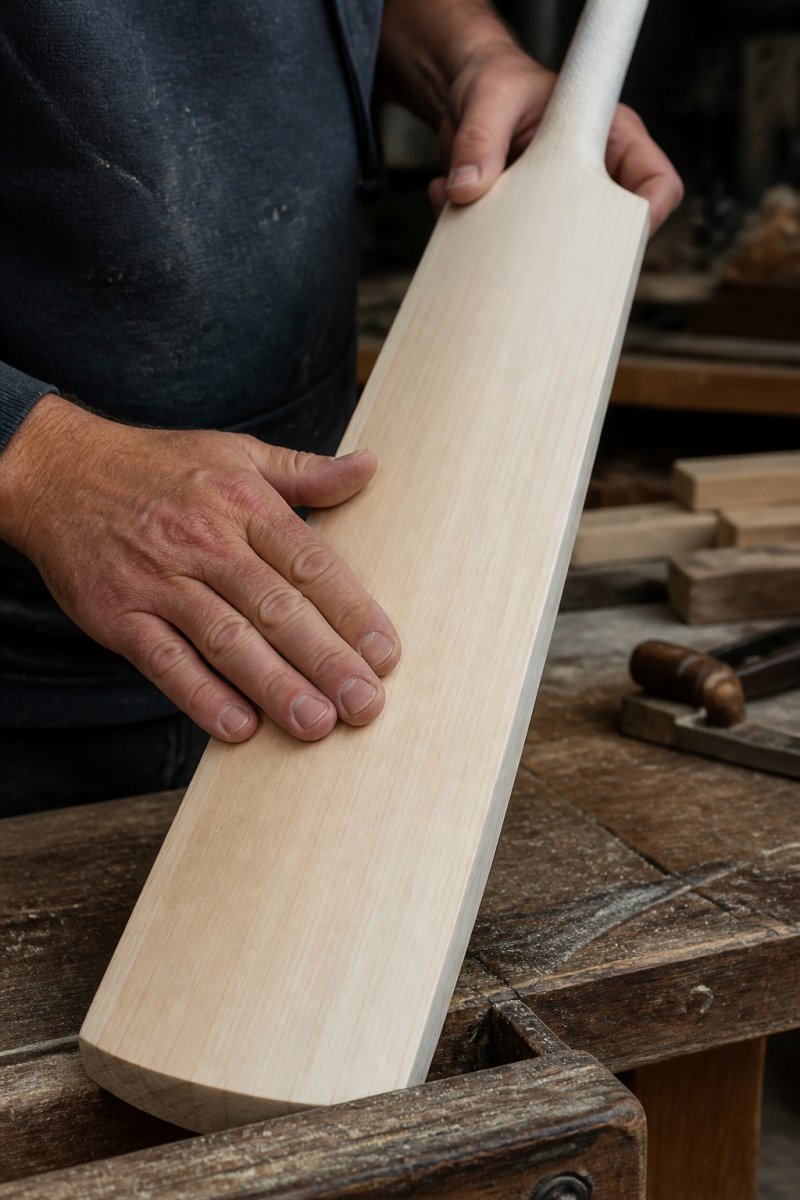
Traditional grading focuses on grains, appearance and colour. At SGM Cricket Bats, we grade on ping instead, because none of those visual markers guarantees performance. Two clefts with identical grain counts can play completely differently once pressed and shaped.
How to Choose an English Willow Cricket Bat That Suits Your Game
Choosing an English willow cricket bat comes down to three things: weight, balance and profile. Get those right and the grade almost does not matter.
Start with weight. A bat you can control through the full swing will score more runs than a heavier bat you cannot get through on time. If a coach has told you your bat is too heavy, listen. Our Players Grade bat sits in the stroke player's weight range for exactly this reason, and it suits openers who play late and soft.
Then look at profile. A duck bill profile gives you more control through the shot. A full profile gives you more power when you are looking to hit through the line.
Players Grade English Willow Cricket Bat | Buy Melbourne →
Finally, check the balance. A bat that feels light in the hands but carries weight in the middle is the goal.
| What to Check | Why It Matters | What Good Looks Like |
|---|---|---|
| Weight | Controls your swing speed | You can play the full range of shots without strain |
| Balance | Affects how the bat feels at pickup | Feels light in hand, carries weight in the middle |
| Profile | Shapes how you score | Duck bill for control, full profile for power |
| Pressing | Decides how the bat pings | Responsive off the middle from day one |
| Handle | Carries the shock of impact | Comfortable grip, no vibration on impact |
Our cricket bat buying guide walks through grade, weight and profile selection if you are still deciding.
Pros and Cons of Grade 4 English Willow
Grade 4 English willow gives you genuine performance at the lowest price point in the willow range. The trade-off is cosmetic, not functional.
Pros:
- Real English willow performance at entry-level pricing
- Same pressing, shaping and balancing as higher grades from a good maker
- Fewer visible grains and more blemishes, which keeps the price down
- Plenty of bat for club cricket, and a sensible first custom bat
- Leaves budget for gloves, pads and training gear
Cons:
- More visible blemishes, stains and colour variation on the face
- Fewer grains, which matters to buyers who want a traditional look
- Harder to resell, because buyers pay for cosmetics
- Will not satisfy a player who wants the cleanest face in the club
Verdict: Who Should Buy Grade 4 and Who Should Step Up
Buy grade 4 if you are a club cricketer who wants a bat that performs without paying for a perfect face. It is the right call for players moving up from junior gear, for anyone buying their first custom bat, and for batters who would rather spend the difference on gloves and pads.
Step up to a higher grade if you want a cleaner face, more grains, or a bat you plan to keep and display. Our Reserve Edition carries a minimum of 8 to 10 grains for players who want the traditional look.
The honest answer to whether grade 4 English willow is good: yes, provided the maker presses and balances it properly. Grade is a label. Ping is the truth.
If you are still unsure which grade suits your game, our custom made bats let you choose willow, weight and profile, and we build each one by hand in our own workshop.
Choosing a bat should not come down to guessing which grade looks best online. At SGM Cricket Bats, we handcraft every bat in our own factory and select willow on ping rather than cosmetics, so you get performance you can feel from the first knock. Our custom made bats let you choose your weight, profile and grip, and our Players Grade and Reserve Edition bats cover both the stroke player and the traditionalist. Get started with SGM Cricket Bats and walk out with a bat built for your game, not a shelf.

Frequently Asked Questions
Is Grade 4 English willow good for a cricket bat?
Grade 4 English willow is perfectly usable for club cricket, particularly at lower grades where the ball is softer and the pace is less demanding. It offers a lower price point and decent performance for batters who are still developing their technique. If you play at a competitive level or face faster bowling regularly, stepping up a grade is worth considering.
What does Grade 4 English willow mean?
Grade 4 English willow refers to the lowest commercial grade of willow used in cricket bats. It typically has more visible blemishes, wider grain lines, and a less consistent colour than higher grades. The wood is still English willow and can perform well when pressed and shaped correctly, but it lacks the cosmetic uniformity of Grade 1 or Grade 2. It is usually the most affordable option for players who want a genuine English willow bat without paying premium prices.
How does Grade 4 willow compare with Grade 1?
Grade 1 English willow has tight, straight grains, minimal blemishes, and a more consistent appearance. Grade 4 has wider grains and more visual imperfections. That said, a well-pressed Grade 4 bat can still score runs at club level. The gap in appearance is real but often less dramatic than the price difference suggests.
How many grains should a good English willow bat have?
Grain count alone does not determine bat quality. A bat with 6 to 8 straight, evenly spaced grains is generally considered good, but the pressing, handle construction, and willow density matter just as much. Some Grade 4 bats have fewer grains and visible blemishes yet perform well because they are pressed correctly. Focus on how the bat feels in your hands and the reputation of the maker rather than chasing a specific grain number.
Can a Grade 4 cricket bat be used for competitive cricket?
Yes, a Grade 4 bat can be used in competitive club cricket, especially in lower grades or on slower pitches. It is still a legitimate option. If you play regularly at a competitive level, consider a Grade 2 or Grade 1 bat. For social or junior cricket, Grade 4 is often more than adequate.


