

Table of Contents
- Why a Knocking Mallet Matters for Your Bat
- What to Look for in the Best Cricket Bat Knocking Mallet
- How to Use a Cricket Bat Mallet Safely
- Cricket Bat Knocking In Time: How Long Does It Take?
- Cricket Bat Mallet vs Old Ball: Which Works Better?
- Mallet Types Compared: A Quick Reference
- Common Mistakes to Avoid When Knocking In
- Conclusion
- Frequently Asked Questions
Last Updated: 20 October 2026
Why a Knocking Mallet Matters for Your Bat
A knocking mallet is the most important piece of bat care equipment you will ever buy, and most club players still get it wrong. At SGM Cricket Bats, we hand-shape every cleft ourselves, and we can tell you plainly: a bat that has never been knocked in will crack, and it will crack early.
Knocking in is the process of compressing the willow fibres on the face and edges of a new bat so they knit together before a hard ball does it for you. Skip it and the first decent pull shot can open a split along the edge. Do it properly and the bat keeps its ping far longer.
The tool matters because a mallet delivers a controlled, repetitive blow you can aim. Your arm cannot do that consistently. A cheap mallet with a soft head does almost nothing, and a mallet that is too heavy dents the face. Below, we break down what separates a good mallet from a bad one, how to use it without damaging your bat, and how long the whole job takes.
What to Look for in the Best Cricket Bat Knocking Mallet
The best cricket bat knocking mallet has a dense, hard head, a handle long enough for a natural swing, and a weight that lets you tap for twenty minutes without your forearm burning. Everything else is detail.
Head Material and Weight
Look for a hardwood head, usually seasoned timber or a dense imported hardwood. The head should feel solid when you tap it against your palm, with no hollow ring. A soft or composite head absorbs the energy you are trying to transfer into the willow, which defeats the purpose.
Weight is the trade-off. A heavier head compresses faster but is harder to control on the edges, where most damage happens. Something in the range of a light training bat is about right for most players. If the mallet feels like a slogger's bat, it is too heavy for edge work.
Handle Comfort and Grip
A mallet handle should feel like a bat handle, not a hammer handle. You will hold it for a long session, so check for a grip that does not twist in a sweaty hand. Rubber or chevron grips work well. Avoid bare polished timber, which slips once your palms warm up.
Length matters too. A longer handle gives you a smoother arc and less strain on the wrist. Short handles force you to chop at the bat, which produces uneven compression.
How to Use a Cricket Bat Mallet Safely
Using a cricket bat mallet safely means tapping with the grain, working from the middle of the face outwards, and never striking the toe or the splice. Those two areas are the most fragile parts of any bat.
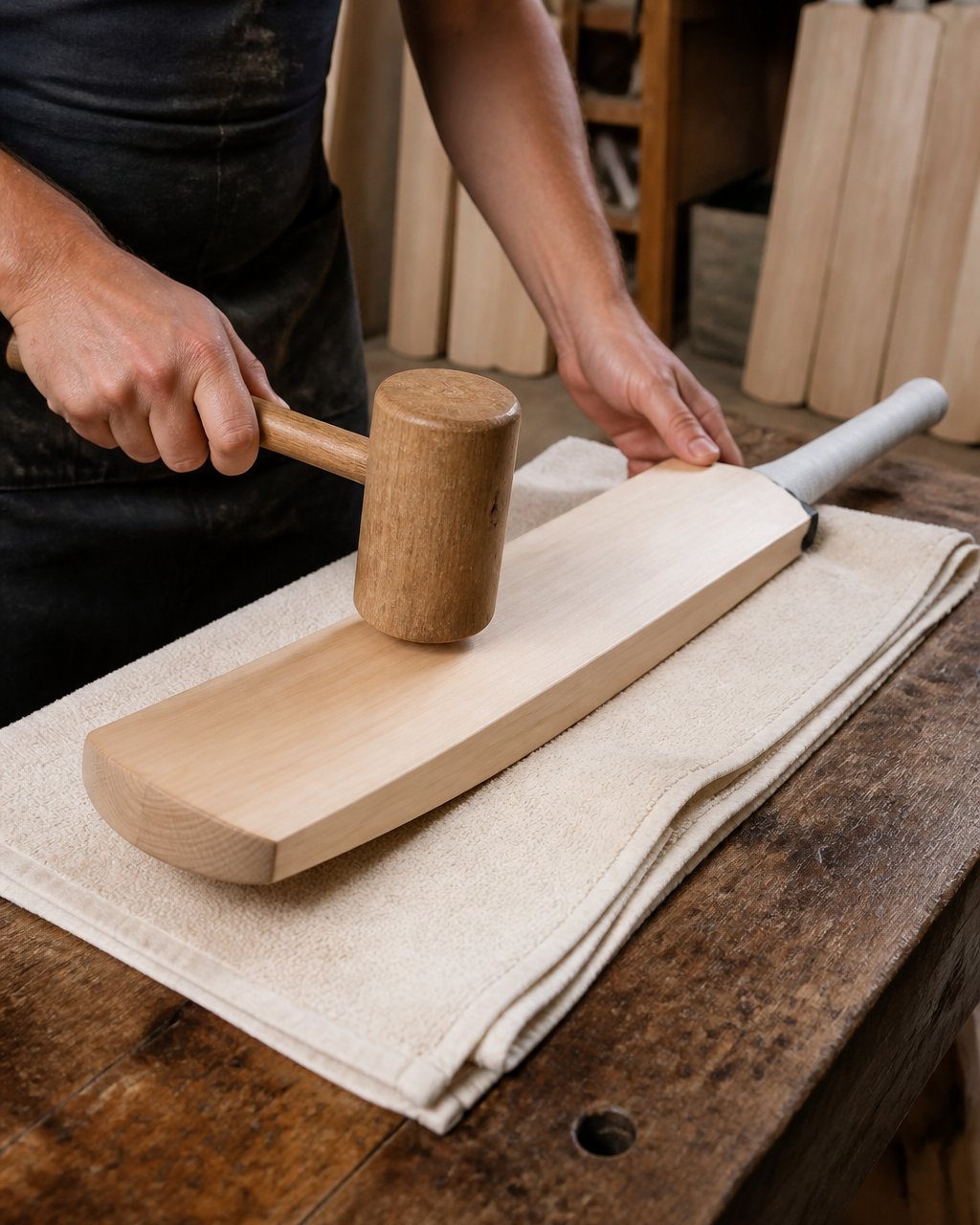
Here is the routine we recommend to every customer who buys a bat from us:
- Lay the bat flat on a folded towel or a soft cloth.
- Start on the face, tapping lightly in the middle, working outwards in slow circles.
- Increase the force gradually over several sessions, never starting hard.
- Move to the edges and tap along them at a slight angle, not straight on.
- Spend extra time on the toe end of the face, where the ball most often hits.
- Stop if you see a hairline crack forming, and let the bat rest.
Cricket Bat Knocking In Time: How Long Does It Take?
Cricket bat knocking in time is usually six to eight hours of total mallet work spread across two to three weeks, plus a session or two in the nets with an old ball. Rushing it is the single most common reason bats fail early.
The exact figure depends on the willow. A harder, denser cleft needs more time. A softer press needs less, but also needs gentler treatment. We tell our customers to break the work into short sessions of twenty to thirty minutes rather than one long marathon, because the willow recovers between sessions and compresses more evenly.
A sensible schedule looks like this:
| Week | Mallet Work | Net Work | Focus |
|---|---|---|---|
| Week 1 | 20-30 min per session, 4 sessions | None | Face, light tapping |
| Week 2 | 30 min per session, 4 sessions | 1 short session, old ball | Edges and toe |
| Week 3 | 30 min per session, 3 sessions | 2 sessions, old ball | Full face, firmer strikes |
| Week 4 | Light touch-ups | Normal nets | Match ready |
If you have a tournament in eight weeks, that timeline fits comfortably. Start now rather than the week before.
Cricket Bat Mallet vs Old Ball: Which Works Better?
A cricket bat mallet beats an old ball for the bulk of the knocking in work, but the old ball still has a role at the end. The mallet compresses the fibres directly and lets you target the edges and toe precisely. An old ball spreads the force over a wider area and cannot reach the edges properly.
Use the mallet for the first two to three weeks. Then take the bat into the nets with an old, hard ball and face throwdowns at moderate pace. This simulates real match contact and shows you where the bat is still stiff. If a particular spot still feels hard or sounds flat, go back to the mallet on that area.
The mistake is treating them as alternatives. They are stages. Mallet first, old ball second, match ball last.
Mallet Types Compared: A Quick Reference
Mallets come in a few broad types, and the right one depends on how much bat care you plan to do. Here is how they stack up.
| Mallet Type | Head Material | Best For | Main Drawback |
|---|---|---|---|
| Traditional hardwood | Dense seasoned timber | Regular bat care, club players | Needs a decent swing to use well |
| Lightweight composite | Composite with hard face | Junior bats, light touch-ups | Less compression per strike |
| Heavy training mallet | Very dense hardwood | Experienced players, hard press bats | Hard to control on edges |
| Dual-purpose roller mallet | Timber head with roller | Players who also want a seam roller | Bulkier to store and carry |
For most club cricketers, a traditional hardwood mallet is the pick. It is the most versatile and the easiest to control across the face and edges. If you are buying for a young player, a lighter composite mallet is easier on the arms.
Common Mistakes to Avoid When Knocking In
Most bat damage we see in our repair workshop traces back to the same handful of knocking in errors. Avoid these and your bat will last seasons longer.
- Starting too hard. Beginners want to see progress fast. Hitting hard on day one dents the face and can start a crack.
- Ignoring the edges. The face gets all the attention, but edges take the most punishment in match play.
- Skipping rest days. Willow needs time to recover between sessions. Daily hammering compresses unevenly.
- Using a soft or worn mallet. A mallet with a rounded or dented head spreads force badly and does little good.
- Knocking in a bat you plan to return. Once you have knocked in a bat, most sellers will not accept a return, so check the specs first.
- Storing the bat damp. Knock in a dry bat, in a dry room, away from direct heat.
If you would rather not do the work yourself, or your bat has already picked up a crack, our bat repair service handles re-handling and structural repairs in our own workshop.
Conclusion
Knocking in a new bat is unglamorous work, but it is the difference between a bat that lasts two seasons and one that lasts six. Get a hardwood mallet with a sensible weight, work in short sessions, cover the edges, and finish with an old ball in the nets.
If you want a bat that arrives ready for that process, our custom-made bats are shaped to your specifications from hand-selected English willow, and every one comes with our guidance on knocking in and care. We build them in our own factory, so we know exactly what each cleft needs.
Shop now with SGM Cricket Bats and start your next bat off on the right foot.
Frequently Asked Questions
Is a cricket bat knocking mallet better than an old cricket ball?
A mallet gives you more control and consistency than an old ball. The flat or rounded head lets you target the edges and toe precisely, and you can vary the force without worrying about the ball bouncing off at an angle. An old ball works in a pinch, but it is harder to direct and can bruise the willow if you strike too hard. For a proper job, especially on a new bat, a dedicated knocking mallet is the better tool.
How long should you knock in a new cricket bat?
Most English willow bats need knocking in, spread over several sessions. Start with short ten-minute rounds and build up gradually. The exact cricket bat knocking in time depends on the willow's hardness and the bat's profile. A mallet lets you work the edges and toe more thoroughly than a ball, so you may finish a little faster, but never rush it. If you hear a dull thud instead of a crisp tap, stop and let the bat rest.
Can you use a rubber mallet to knock in a cricket bat?
A rubber mallet is too soft and bouncy for proper knocking in. It will not compress the willow fibres effectively and can leave a dead feeling in the bat. Look for a mallet with a hard, dense head, usually made from hardwood or a hard composite. The best cricket bat knocking mallet has enough weight to do the work without you having to swing hard, which helps you avoid over-hitting the edges.
What should you look for in a cricket bat knocking mallet?
Check the head material, weight and handle. A hardwood or dense composite head gives good control. The handle should be comfortable and secure, with a grip that does not slip when your hands get sweaty. Avoid mallets that are too light, as you will end up swinging harder than necessary. If you are unsure, ask the bat maker you bought from for a recommendation that suits your bat's willow grade.
A bat that has been knocked in properly plays better from the first ball, and a bat built for your game plays better still. Our team shapes every cleft by hand and can talk you through the right profile, weight, and handle for your style before you commit. Get started with SGM Cricket Bats and give your next innings the equipment it deserves.


