

Table of Contents
- Handcrafted vs Factory Cricket Bats: Key Differences
- Manufacturing Process: Handcrafted and Factory Methods
- English Willow Grading Explained
- Best Cricket Bat for Power: Handcrafted Advantage
- Cricket Bat Maintenance and Knocking In
- Durability and Lifespan Comparison
- Which Option Is Right for Your Game
- Frequently Asked Questions
Last updated: 8 October 2026
Handcrafted vs Factory Cricket Bats: Key Differences
Should you pay for a handcrafted bat, or is a factory-made bat the smarter buy for your level of cricket? This guide is a decision tool for club players weighing the two options, covering where each one wins on customisation, consistency, durability and lead time. If you have already decided to go handcrafted and want to see prices, grades and how to order, head straight to our handcrafted cricket bat buying guide.
Handcrafted bats are built by skilled craftspeople who select individual willow clefts and shape each bat to precise specifications. Factory bats are manufactured using standardised processes and machinery, with less variation between units. The real difference lies in customisation, quality control, and how the bat responds in your hands. The answer is not as simple as "handcrafted is always better", because both approaches have genuine strengths.
Manufacturing Process: Handcrafted and Factory Methods
Handcrafted bat production begins with cleft selection. A craftsperson examines raw English willow, assessing grain structure, density, and wood quality by eye and feel. This human judgment is irreplaceable, no machine can reliably predict how a piece of willow will perform once pressed and shaped.
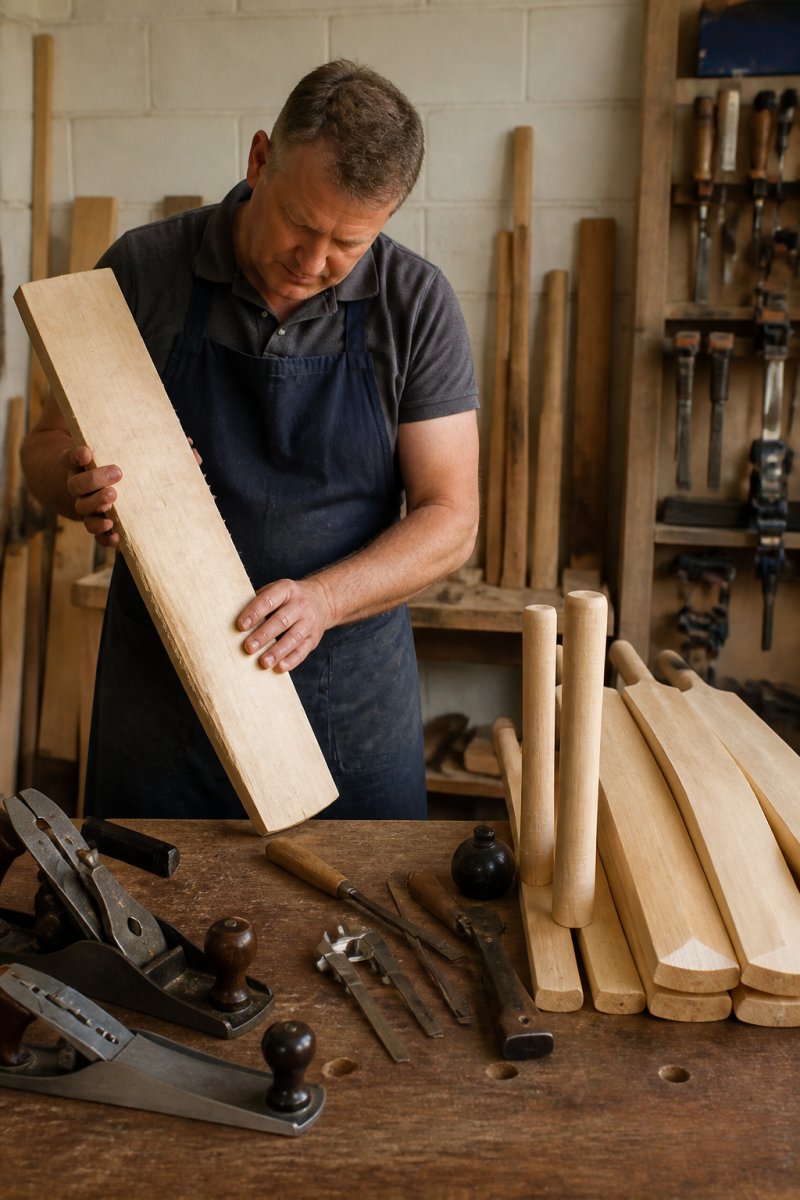
Once a cleft is chosen, the bat is hand-shaped using chisels, planes, and sanders. The craftsperson adjusts weight distribution, profile, and edge thickness based on the wood's characteristics and the player's specifications. This means two "identical" handcrafted bats from the same maker will have subtle differences because the willow itself varies.
Factory manufacturing follows a different logic. Standardised willow clefts are selected by grade, typically Grade 1, Grade 2, or Reserve, based on grain count and visual appearance. Machinery then shapes the bat to a fixed template. The benefit is consistency: every bat off the production line has the same dimensions and weight within tight tolerances. The trade-off is less room for personalisation.
SGM Cricket Bats manages its own factory in Melbourne, which means we oversee every step from cleft selection through final inspection. This hybrid approach, using factory equipment but with craftspeople making critical decisions about wood selection and customisation, gives us control over both consistency and personalisation that purely outsourced manufacturing cannot match.
English Willow Grading Explained
English willow grading is where handcrafted and factory approaches diverge most visibly. The traditional grading system focuses on grain count, colour, and visual blemishes. Grade 1 has the most grains and fewest cosmetic flaws. Grade 2 has fewer grains and may show minor stains or colour variation. Reserve grade is Grade 1+ willow with 6 to 12 straight grains and premium selection.
Here's what most players get wrong: grain count does not directly determine performance. A bat with fewer grains can outperform one with more grains if the wood density and pressing are superior. Factory grading systems rely on visual appearance because it's easy to measure and standardise. Handcrafted makers can afford to ignore cosmetics and select purely on how the wood feels and sounds.
At SGM Cricket Bats, our Performance Grade bats are selected on ping performance, not appearance. A Performance Grade bat may have fewer visible grains or minor stains, but the wood itself performs at a level that justifies the lower price. Our Players Grade and Reserve Grade bats use premium Grade 1 English willow, offering both visual appeal and proven performance.

| Willow Grade | Grain Count | Cosmetic Standard | Best For | Typical Application |
|---|---|---|---|---|
| Grade 1 | 8 to 12 grains | Pristine appearance | Stroke players wanting bat speed | Players Grade bats |
| Grade 2 | 6 to 9 grains | Minor stains or colour variation | Performance-focused players | Performance Grade bats |
| Reserve (Grade 1+) | 6 to 12 straight grains | Premium selection | Serious club cricketers | Reserve Edition bats |
Factory production relies on grading because it's objective and scalable. Handcrafted makers can afford subjectivity because they're making fewer bats and can afford to spend time on each cleft. Neither system is wrong, they simply serve different purposes.
Best Cricket Bat for Power: Handcrafted Advantage
Power in cricket comes from three elements: bat weight, edge thickness, and sweet spot size. Handcrafted bats excel at optimising all three for your specific swing.
A handcrafted bat can be shaped to match your exact weight preference and playing style. If you're a power hitter who swings hard, a craftsperson can thicken the edges, lower the centre of mass, and adjust the balance point to maximise the sweet spot. If you're a stroke player who relies on timing, they can build a lighter bat that rewards technique over force.
Factory bats offer fixed profiles, typically either a full profile for power or a duck-bill profile for control. You choose which suits you, but you cannot customise beyond that choice. This works well for players whose style fits neatly into one category. It's less effective for players with hybrid techniques or unusual preferences.
SGM Cricket Bats' handcrafted approach means your bat is built around your swing, not the other way around. Our craftspeople can adjust edge thickness, weight distribution, and balance point during production, creating a bat that feels alive in your hands rather than one you have to adapt to.
Custom Made Cricket Bats | Buy Melbourne →
Cricket Bat Maintenance and Knocking In
Both handcrafted and factory bats require knocking in before match use. This process compresses the wood fibres, preparing the bat for impact and reducing the risk of damage.
Knocking in typically takes 8-10 hours of gradual use: starting with a leather ball and light strikes, then progressing to harder hits over several weeks. Factory bats often arrive pre-knocked using machines, which speeds up the process but cannot replicate the nuance of hand-knocking.
Maintenance differs slightly between the two. Handcrafted bats, having been shaped by hand, sometimes develop minor stress marks during knocking in, this is normal and does not indicate a fault. Factory bats, being more uniformly pressed, tend to show fewer cosmetic changes during knocking in.
Both types benefit from regular oiling (linseed oil applied sparingly to the face and edges) and storage in a cool, dry environment. Avoid leaving either type in direct sunlight or damp conditions, as willow is sensitive to moisture and heat.
SGM Cricket Bats offers a knocking-in service if you prefer professional preparation, and our bat repair service in Melbourne handles any damage that occurs during use, whether from normal wear or impact.
Durability and Lifespan Comparison
Handcrafted and factory bats have comparable lifespans when properly maintained, typically lasting 3-5 years of regular club use before the wood begins to fatigue. The difference is how they fail.
Both types can develop edge damage, handle splinters, or minor cracks with heavy use.
Which Option Is Right for Your Game
Choose a handcrafted bat if you're a serious club cricketer or above, you have a clear sense of your playing style, and you're willing to invest in a bat built specifically for you. Handcrafted bats take 3 weeks to produce, so you need to plan ahead. The customisation and personal attention make them worth the timeline if you're playing competitive cricket.
SGM Cricket Bats specialises in handcrafted bats because we believe the customisation and wood selection process creates superior performance for serious players. Our custom-made bats start at $699 and are ready to ship within 3 weeks. If you're unsure which grade or weight suits you, our cricket bat buying guide walks you through the selection process, and we're available to discuss your playing style before you commit.

Choosing between handcrafted and factory cricket bats comes down to your commitment level and timeline. Handcrafted bats deliver superior balance and performance when built by someone who understands your game. SGM Cricket Bats offers custom-made bats tailored to your exact specifications, with expert guidance on willow grade, weight, and profile. Explore our custom bat configurator to build the bat that matches your play style, or contact our team in Melbourne for personalised advice on bat selection and maintenance.
Frequently Asked Questions
What are the main differences between handcrafted and factory-made cricket bats?
Handcrafted bats are built individually with personal attention to cleft selection, weight distribution, and profile customisation. Factory-made bats follow standardised production lines with preset specifications. Handcrafted bats allow you to specify exact weight, balance point, and grip preference, whereas factory options offer limited customisation. The handcrafted process typically takes 3 weeks, while factory bats are mass-produced for immediate availability.
Does a handcrafted cricket bat offer better performance for power hitting?
Handcrafted bats can deliver superior power when built to your specifications. The ability to select willow grade, adjust weight distribution, and choose your profile means the bat is optimised for your playing style. A bat matched to your technique and strength unlocks natural bat speed and sweet spot consistency. However, performance depends on proper knocking in and maintenance.
How does the cleft selection process differ between custom and factory bats?
Custom bats begin with careful cleft selection based on grain density, ping response, and wood quality rather than cosmetics alone. Craftspeople assess each piece individually for performance characteristics. Factory production selects clefts by visual grading standards (grain count and appearance), then processes them in batches. This means handcrafted bats prioritise how the wood performs at the crease, whilst factory methods prioritise consistency and appearance.
Are handcrafted cricket bats more durable than mass-produced ones?
Handcrafted bats typically last longer when properly maintained. Superior willow selection, careful pressing, and quality handle construction reduce fatigue and edge damage over time. Durability depends on your maintenance routine, regular knocking in, oiling, and proper storage extend any bat's lifespan significantly.


