

Table of Contents
- What Causes Fibre Compression in a Cricket Bat?
- Signs of Cricket Bat Over-Compression You Should Never Ignore
- What You'll Need to Protect Your Bat
- Step 1: Prepare the Willow with the Best Oil for English Willow Bats
- Step 2: Follow a Proper Cricket Bat Knocking In Guide
- Step 3: Store and Rotate Your Bat to Prevent Fibre Compression
- Common Mistakes That Cause Fibre Compression
- Frequently Asked Questions
Last Updated: September 13, 2026
What Causes Fibre Compression in a Cricket Bat?
Fibre compression is the permanent crushing of the willow's internal cells that occurs when a bat takes repeated impact before the timber has hardened enough to cope with it. In practical terms, the fibres lose their spring, the face dents rather than rebounds, and the bat goes flat.
Three things drive it. The first is under-preparation: a bat that never receives enough knocking in takes full-force impact on soft, unseasoned fibres. The second is moisture imbalance, where a bat is either too dry (brittle, cracks along the grain) or too wet (soft, compresses under the ball). The third is workload, since even a well-prepared bat used in the nets every day with no rotation will fatigue faster than one shared across a rotation.
Here's where most players get it wrong: they treat fibre compression as something that happens to cheap bats. It doesn't. It happens to any bat, including top-grade English willow, when preparation and care are skipped. The grade of the willow changes how much punishment it absorbs before damage sets in, not whether damage is possible.
At SGM Cricket Bats, we see this constantly in bats sent back for assessment: excellent clefts, poor preparation. The willow was never the problem.
Signs of Cricket Bat Over-Compression You Should Never Ignore
Over-compression announces itself long before the bat dies. Catch these signs early and you can often extend the bat's useful life by months.
- A dull, dead sound on impact. A healthy bat produces a sharp crack; a compressed one thuds.
- Visible face indentations that stay after the ball has gone, rather than springing back.
- Loss of "ping" in the middle, particularly noticeable on drives where you middled it and got nothing.
- Hairline cracks along the face running with the grain, not across it.
- A soft, spongy feel when you press a thumbnail into the face near the toe.
- Excessive vibration into the hands on shots that used to feel clean.
The distinction that matters is between normal surface marking and compression. Every bat picks up scuffs and minor indentations. Compression is when those indentations deepen, don't recover, and the performance drops with them.
What You'll Need to Protect Your Bat
Preparation is cheap. Replacement is not.
- Raw linseed oil (not boiled, not a blended furniture oil)
- A clean, lint-free cloth for applying oil
- A wooden bat mallet with a rounded face
- An old cricket ball for the final stage of knocking in
- A bat cover or sleeve for transport and storage
- A cool, dry storage spot away from heaters, car boots and direct sun
That list costs very little compared with a new bat. It also covers everything you need for the three steps that follow.
Step 1: Prepare the Willow with the Best Oil for English Willow Bats
Raw linseed oil is the best oil for English willow bats, because it penetrates the timber slowly and conditions the fibres without sealing the surface. Boiled linseed oil cures too fast and sits on top of the wood, which traps moisture rather than balancing it.
Apply it sparingly. Two to three thin coats, each wiped on with a cloth and left to dry for 24 to 48 hours, is the standard approach. A common mistake is drowning the bat: if the face feels tacky or the oil is sitting on the surface after a day, you've used too much, and an over-oiled bat plays heavy and dead.
Focus on the face, the toe and the edges. Never oil the splice, the handle or the stickers, and never stand the bat in a pool of oil to soak.
guidance on timber moisture content and wood conditioning
Step 2: Follow a Proper Cricket Bat Knocking In Guide
A proper cricket bat knocking in guide comes down to one principle: gradually increase the force the willow absorbs, so the fibres harden progressively rather than all at once. Rushing this stage is the single most common cause of fibre compression in bats.
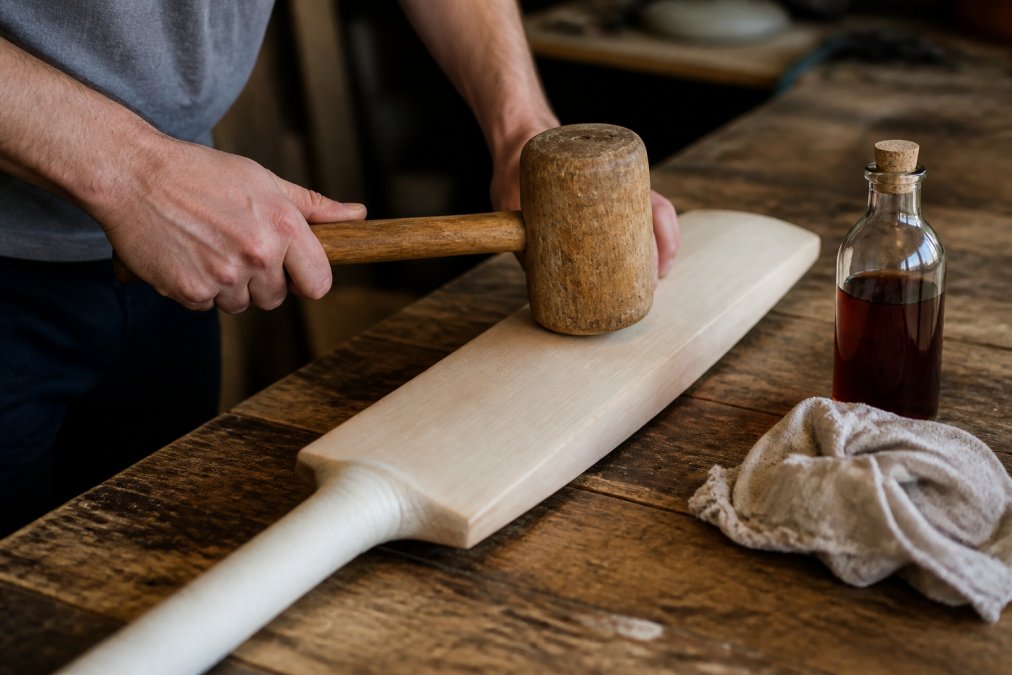
The sequence:
- Edges first. Use the mallet at a shallow angle, working along both edges for 10 to 15 minutes per session.
- The face, in bands. Work the mallet across the face in overlapping strips, avoiding the middle initially.
- The toe. Light, patient taps. The toe is the thinnest part of the bat and the most easily damaged.
- The middle, last. Once the face has taken on a consistent, slightly rounded sheen, begin working the middle.
- Progress to an old ball. After several sessions with the mallet, move to throwing an old ball into the face, then graduate to net throwdowns before facing pace.
Spread this over a week or more. A bat knocked in over five short sessions will outlast one hammered for three hours straight (cricketvictoria.com.au).
Step 3: Store and Rotate Your Bat to Prevent Fibre Compression
Storage and rotation are the two habits that separate a bat that lasts three seasons from one that lasts one.
Store your bat in a cool, dry place, ideally in a cover or sleeve. Heat is the enemy: a car boot in summer, a shed with a tin roof, or a spot next to a heater will dry the willow out and make the fibres brittle. Equally, a damp garage will leave the bat soft and prone to compression.
Rotation matters just as much. If you own two bats, alternate them. A bat given recovery time between sessions retains its spring far longer than one used every single day. For players training four or more times a week, a second bat isn't a luxury, it's maintenance.
SGM Cricket Bats handcrafts custom bats in its own factory and offers repair and re-handling services, which means a bat showing early compression can often be assessed and corrected rather than replaced.

Common Mistakes That Cause Fibre Compression
Most compression damage traces back to a short list of avoidable errors.
| Mistake | What It Does | The Fix |
|---|---|---|
| Skipping or rushing knocking in | Fibres take full impact while still soft | Spread preparation over 5+ sessions |
| Over-oiling the face | Traps moisture, bat plays heavy and dead | 2-3 thin coats, 24-48 hours apart |
| Storing in heat or damp | Dries fibres out or leaves them soft | Cool, dry spot, always in a cover |
| Using one bat every session | No recovery time between impacts | Rotate across two bats |
| Ignoring early warning signs | Minor compression becomes structural damage | Stop at the first dull sound |
| Facing new-ball pace too early | Shock loading on unprepared willow | Net throwdowns before match pace |
The thread running through all of these is impatience. Willow is a natural material, and it responds to gradual, consistent treatment. There's no shortcut that doesn't cost you performance later.
If you'd rather start with a bat that's already been prepared with this in mind, SGM Cricket Bats offers handcrafted custom bats built to your specifications, along with players' grade, performance grade and reserve edition options across the range.

Preventing fibre compression in bats is really a question of discipline: oil sparingly, knock in patiently, store sensibly, and rotate your gear. Do those four things and the willow rewards you with years of ping rather than a flat, dead blade by mid-season.
At SGM Cricket Bats, every bat is handcrafted in our own factory, from cleft selection through to final inspection, so we can build a bat around your weight, profile and playing style, and back it with repair and re-handling services when it needs attention. If you want a bat made to last rather than one that goes flat, explore our custom-made range and get started with SGM Cricket Bats today.
Frequently Asked Questions
What causes fibre compression in cricket bats?
Fibre compression happens when willow fibres are crushed by repeated impact, especially from new balls or edges. It builds up faster if you skip knocking in, over-oil the bat or leave it in a hot car. Using a bat with too little preparation means the fibres never harden gradually, so they flatten instead of flexing.
Does knocking in a bat help prevent fibre compression?
Yes. A proper cricket bat knocking in guide is the single best defence against fibre compression. Knocking in compresses the surface fibres gradually with a mallet, so they harden and knit together before facing a hard ball. Spend around six hours across the face edges and toe. If you rush this stage, the bat will compress unevenly and lose ping sooner, even if the willow is top grade.
What are the signs of cricket bat over-compression?
Look for a dead, flat sound instead of a sharp crack, a noticeable dip or dent in the middle, and cracks that run along the grain rather than across it. Over-compressed bats also feel heavy through the swing because the fibres have lost their spring. If you spot these signs early, rest the bat and switch to a softer ball in the nets to slow further damage.
Can a compressed cricket bat be repaired?
Minor surface compression can sometimes be improved with light sanding, re-oiling and a fresh knocking-in session, but deep fibre compression is permanent. Once the internal fibres are crushed, the bat will not recover its original ping. SGM Cricket Bats offers repair and re-handling services, and if the damage is severe, a custom-made bat built to your specifications is the more reliable long-term option.


