

Table of Contents
- What the Custom Cricket Bat Fitting Process Involves
- How to Measure for a Custom Cricket Bat
- English Willow Cricket Bat Grades Explained
- Cricket Bat Weight and Balance Guide
- What to Expect During Your Fitting Session
- Preparing for Your Custom Bat Fitting
- The SGM Timeline: From Cleft Selection to Delivery
- Conclusion
- Frequently Asked Questions
Last Updated: September 5, 2026
A custom cricket bat fitting process is the step-by-step method of selecting and shaping a bat to match your height, stance, shot selection and personal feel, rather than adapting your technique to a mass-produced stick. The process matters because a bat that is balanced for your swing can improve timing and shot placement without you changing a thing about how you play. In this guide from SGM Cricket Bats, we break down the full journey, from taking your measurements to the day the bat lands in your hands.

What the Custom Cricket Bat Fitting Process Involves
The custom cricket bat fitting process is more than picking a weight off a rack. It is a structured consultation that translates how you bat into physical specifications. A fitter assesses your stance, the length of your backlift, where you score your runs, and whether you favour front-foot drives or back-foot cuts.
Those observations determine the bat's profile, swell position and handle shape. A front-foot player typically wants a lower swell for punchy drives, while a back-foot dominant batter benefits from a higher swell to help the ball travel off the back foot.
A proper fitting also reveals preferences you may not have articulated, such as a dislike for thick edges or a need for a softer feel through the hands. Once the fitter understands these details, they translate them into a specification sheet that guides the bat maker.
How to Measure for a Custom Cricket Bat
Measuring for a custom cricket bat starts with the most reliable indicator: your height. Stand in your normal batting stance, and the bat should rest comfortably on the crease with the toe just touching the ground. The handle should sit neatly in the fold of your front hip, not jammed into your stomach or floating above it.
The measurement that matters most is the distance from the ground to the top of your front hip while in stance. This determines the overall length of the bat. Many players mistakenly buy based on their age or shoe size, which leads to bats that are either too long and heavy through the pickup or too short and light.
Handle Length and Blade Size
Handle length and blade size work together to create the bat's overall length. A short handle shifts more mass into the blade, which suits players who like a heavier pickup and more power through the middle. A long handle moves mass upward, creating a lighter feel that rewards quick hands and late shots.
Blade size follows your shot selection. Players who defend and rotate strike prefer a compact face with a lower middle. Aggressive batters who clear the infield tend to favour a larger face with a high middle. These choices also affect edge thickness, which changes how the bat performs on mis-hits.
The important point is that these specifications are not arbitrary. They are directly traceable to the measurements and playing style you discussed in your fitting. For a detailed breakdown of length, weight and profile selection, Cricket Australia's junior bat sizing guide offers a useful starting point.
English Willow Cricket Bat Grades Explained
English willow grades explain the quality and appearance of the wood used in your bat. The grade affects both price and, to a degree, performance potential, which is why it is a central decision in the custom cricket bat fitting process.
Grade 1 willow offers the straightest grains and the cleanest appearance, making it the choice for professional players. Grade 2 willow, often called Players Grade, may show minor blemishes or slightly less straight grains but performs comparably. Grade 3 and below, sometimes labelled Performance Grade, can have wider grains or visual marks that do not necessarily reduce how well the bat plays.
The misconception is that a higher grade automatically means a better bat. In practice, the ping of the willow, which is how the ball leaves the blade, matters more than the visual grain count. A bat maker who selects clefts by sound rather than appearance can deliver a Grade 2 bat that outperforms a prettier Grade 1. The science behind willow selection is well documented, and research on English willow properties from the University of Cambridge explains why grain structure alone does not determine performance.
Cricket Bat Weight and Balance Guide
Cricket bat weight and balance guide your feel through the swing, and they are two separate things. Weight is the total mass of the bat, typically ranging from 1.1 kg to 1.3 kg for adult players. Balance is where that mass sits along the length of the bat.
A bat with a low balance point feels lighter than its actual weight because the mass sits closer to your hands. This suits players who need quick reactions. A bat with a high balance point places more mass toward the toe, which generates greater power but requires stronger wrists and forearms to control.
The right weight for you depends on your strength and technique, not on what the professionals use. A common mistake is choosing a bat that is too heavy because it felt powerful in the shop, only to find your shot timing suffers late in an innings when fatigue sets in. Choose the lightest bat that still lets you play your natural shots with authority.
What to Expect During Your Fitting Session
A fitting session typically begins with a conversation about your cricket history and current equipment. Be ready to answer questions about your batting average, the level you play at, and what you dislike about your current bat. Honest answers here save time later.
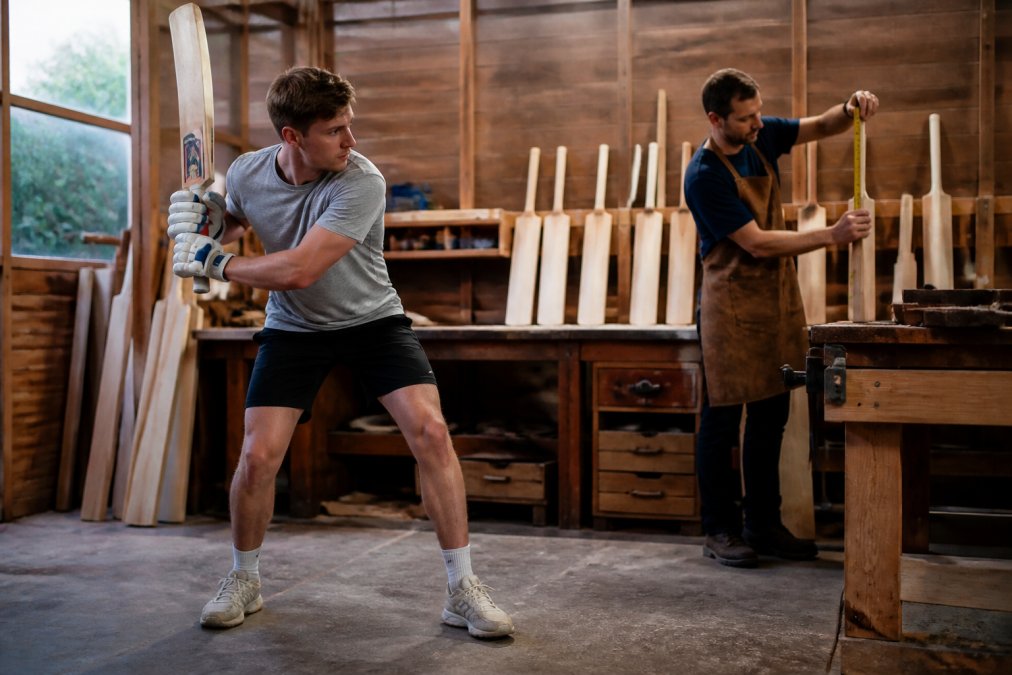
The fitter will then watch you shadow bat and take a few practice swings. They are observing your stance width, your backlift height, and the path of your bat through the hitting zone. You may be asked to try bats of different weights and profiles so the fitter can see which one looks most natural in your hands.
You should leave the session with a clear specification sheet. This documents your chosen willow grade, overall length, handle type, blade size, weight and balance point. If you are working with SGM Cricket Bats, you can also discuss deep customisation options such as grip type and edge profile during this stage.
Preparing for Your Custom Bat Fitting
Preparation for your custom bat fitting is straightforward, but a few steps will make the session far more productive. Bring your current bat, even if you hate it. The fitter can identify what is wrong with it and ensure the new bat corrects those faults rather than repeating them.
Take note of where you score your runs and where you get out. A player who edges often may need a different blade profile, while someone bowled through the gate might benefit from a different swell position. These patterns tell the fitter more than any verbal description.
Wear the shoes and gloves you play in, and bring your preferred grip thickness if you have one. Finally, arrive with realistic expectations about timeline and budget. Understanding how professional bat makers approach the fitting and knocking-in process will help you appreciate why a handcrafted bat takes time to prepare.
The SGM Timeline: From Cleft Selection to Delivery
The timeline at SGM Cricket Bats runs to roughly three weeks from the day you confirm your willow. The process begins with cleft selection, where a bat maker chooses the specific piece of English willow based on its ping and suitability for your specification.
Once selected, the cleft is shaped into a blade and the handle is fitted. The bat is then profiled to your exact swell and edge dimensions before being balanced to the agreed weight. After final sanding and the application of your chosen grip, the bat undergoes inspection and is prepared for delivery.
This three-week window is why planning ahead matters. If you have a finals series or a representative carnival approaching, order your bat at least a month in advance. That buffer allows for the knocking-in process, which prepares the bat for match use and should never be rushed. The official guidance on preparing and maintaining a new cricket bat from the MCC explains why this period is essential for performance and durability.
Conclusion
Choosing a bat through the custom cricket bat fitting process removes the guesswork from the most important piece of equipment you own. You will invest time in measurements and honest conversations about your game, and you will wait a few weeks for the bat to be made. That investment pays back in a bat that feels like an extension of your arms rather than a tool you must adapt to. SGM Cricket Bats manages every step from cleft selection to final inspection in its own Melbourne factory, so your specifications are never lost in translation. Get started with SGM Cricket Bats and order a custom bat built around how you actually play.
Frequently Asked Questions
What are the benefits of a custom fitted cricket bat?
A custom fitted cricket bat is tailored to your height, stance, and playing style. This means the handle length, blade profile, weight, and balance point work with your natural technique rather than against it. Most players find they can swing a well-balanced bat faster, time the ball more consistently, and feel more confident at the crease. For club cricketers, the main gain is consistency: the bat feels like an extension of your arms from the first net session, so you spend less time adjusting and more time scoring runs.
How do I measure for a custom cricket bat?
The two key measurements are handle length and blade size. Stand with your normal batting stance and rest the toe of the bat on the ground next to your front foot. The bottom of the handle should sit just below your top hand when your arms hang naturally. For blade size, the bat should reach your hip when the toe is on the ground. If you're between sizes, most players prefer the shorter option for better control. During an SGM fitting, we walk you through these measurements and confirm them against your height and stance.
Does the weight of a cricket bat affect my batting technique?
Yes, it directly affects your shot timing and bat speed. A bat that is too heavy forces your hands to drop late, especially against pace, and you will mistime drives and pulls. A bat that is too light may feel easy to swing but lacks the mass to push the ball to the boundary. The ideal weight depends on your strength, technique, and the level of cricket you play. SGM offers bats, and we recommend matching weight to your natural swing rather than trying to lift more in the gym.
What is the difference between short handle and long handle cricket bats?
Short handle bats suit players under roughly 183 cm tall, while long handle bats suit taller players whose bottom hand sits lower on the grip. The handle length changes where your bottom hand rests, which affects your reach and control through the shot. A short handle on a tall player forces a cramped stance; a long handle on a shorter player makes the bat feel unwieldy. During a custom fitting, we measure your stance height to determine which handle length lets you play with a relaxed, natural position at the crease.
How long does the SGM Cricket Bats custom fitting process take?
The full process takes about three weeks from the day you choose your willow. This covers cleft selection, pressing, shaping, handle fitting, and final inspection in our Melbourne factory. The fitting consultation itself, whether in person or online, takes roughly 30 minutes. If you have a tournament or season start approaching, let us know your timeline when you begin the process. We can advise on whether a custom bat fits your schedule or whether one of our ready-made performance bats is a better option for immediate delivery.


