

Table of Contents
- What to Look for in a Cricket Shop Near Me
- How to Choose a Cricket Bat: A Practical Framework
- Cricket Bat Size Guide: Match the Blade to the Player
- Junior Cricket Bat: Made to Order, Not Off the Shelf
- Cricket Batting Pads and Gloves: Getting the Fit Right
- Cricket Shop Near Me: What to Ask Before You Order
- Conclusion
- Frequently Asked Questions
Last Updated: October 5, 2026
What to Look for in a Cricket Shop Near Me
A cricket shop near me is only worth your time if it can answer one question: does it sell gear that fits you, or just gear that fills a shelf? That distinction matters more than postcode. At SGM Cricket Bats, we handcraft English willow bats in our own factory and ship them Australia-wide, so we have a clear view of what separates a real cricket shop from a warehouse with a bat rack.

Three things decide whether a shop deserves your money:
- Custom capability. Can they build to your weight, profile and grip, or only sell what is boxed?
- Honest grading. Do they explain why a bat plays well, or just quote grain counts?
- After-sales service. Can they repair, re-handle and re-oil a bat you already own?
Price transparency helps too. Fixed, published pricing beats a quote that shifts once you are in the door.
If a shop cannot tell you the weight of a bat in pounds or the profile it uses, walk away. The MCC Laws of Cricket set the bat's legal limits, but only the maker can tell you how theirs actually picks up.
How to Choose a Cricket Bat: A Practical Framework
Choosing a cricket bat comes down to matching three variables, weight, profile and willow grade, to how you actually bat. Everything else is marketing.
Start with how you score runs. If you time the ball and place it, you want a lighter blade. If you hit through the line and rely on power, you want mass behind the middle. Get that wrong and no amount of grain counting will save you.
Here is the framework we use with customers:
- Weight first. A bat that feels heavy in the changing room feels heavier at 4pm on day two.
- Profile second. Duck bill shapes suit control; full profiles suit hitting.
- Grade last. Grade affects appearance and price more than it affects ping.
- Handle and grip. These decide how the bat sits in your hands, so choose them deliberately.
Weight and Pickup: The Spec That Decides Everything
Pickup is how heavy a bat feels when you swing it, and it matters more than the number on the sticker. Two bats can both read 2.10 lbs and feel completely different because of where the mass sits.
Our Players Grade English Willow Cricket Bat runs from 2.6 to 2.12 lbs, and that lighter end is deliberate. It suits openers who play late, players whose backlift shortens under pressure, and anyone a coach has told their bat is too heavy. Female cricketers and shorter players often find a full-size blade at that weight far easier to manage.
A common mistake is buying the heaviest bat you can lift in a shop. You can lift it standing still. Try lifting it after 90 overs in the field.
Profile, Edges and Sweet Spot
Profile describes the shape of the blade, and it changes where the bat's power lives. Thicker edges give you a larger sweet spot and more power off the middle, but they add mass you have to swing.
We offer two shapes across our range:
- SS Duck Bill Profile for enhanced control, better for players who work the ball around.
- Full Profile for powerful hitting, better for players who dominate bowlers.
The sweet spot position follows the profile. A lower sweet spot suits front-foot players; a higher one suits back-foot play. Ask which you are getting before you order, because you cannot change it later.
Cricket Bat Size Guide: Match the Blade to the Player
Cricket bat sizing comes down to height, and the quickest check is to stand the bat beside the player's leg. A correctly sized bat reaches roughly to the top of the thigh when the player stands straight.
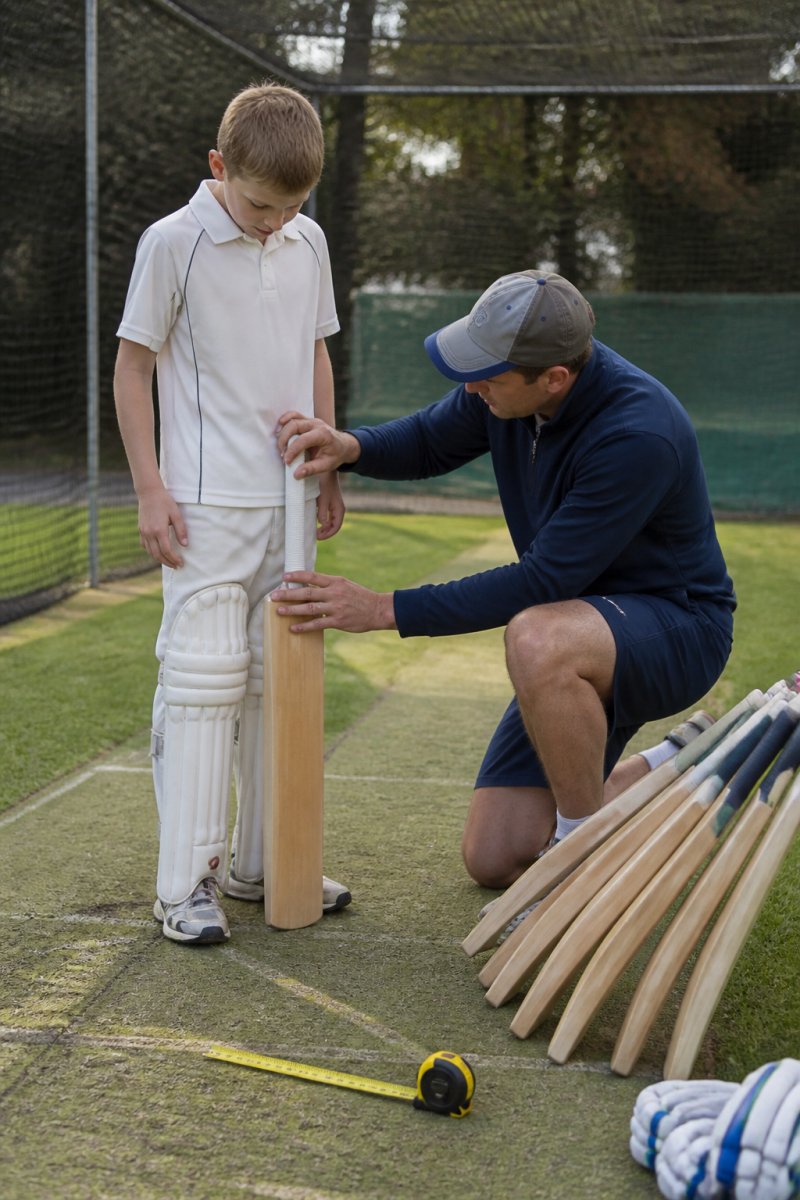
Our own sizing guidance works off height bands:
- Harrow: shorter adults and older juniors who need a full-size feel.
- Full size (SH): most adult players.
The Cricket Australia junior participation guidance consistently points to properly fitted equipment as a major factor in whether kids enjoy the game and keep playing.
Get the size wrong and technique suffers. A bat that is too long drags the toe; one that is too short forces you to reach. Neither is a coaching problem. Both are a sizing problem.
Junior Cricket Bat: Made to Order, Not Off the Shelf
Every junior bat we make is built to order, sized and weighted for the individual player.
Players Grade English Willow Cricket Bat | Buy Melbourne →
That is a deliberate choice, and it is the opposite of how most retail works.
Building to order fixes that. We match the weight to the player's strength, the size to their height, and the profile to how they are being coached. It takes about three weeks, which is why we ask parents to plan around the season rather than the week before it.
If your junior is moving from soft ball to hard ball this season, that transition is exactly when sizing and weight matter most. A bat built for them will do more for their technique than any coaching drill.
Cricket Batting Pads and Gloves: Getting the Fit Right
Batting pads and gloves protect you best when they fit properly, and fit is measured, not guessed. Pads are sized by knee-to-instep length; gloves are sized by hand length and handedness.
Our Player Grade Cricket Batting Pads are built for comfort across long innings, with sweat-absorbent lining and a light feel. Sizing runs from Small Boys through to Large Men, with Boys, Small Men and Men filling the middle. Measure from the centre of the knee to the top of the foot and match that to the chart.

Gloves are simpler but no less important. Our Elite Sausage Finger Batting Gloves use traditional sausage finger construction, which spreads impact across the finger rather than concentrating it on one joint. They come in right-hand and left-hand options, and the adjustable wrist strap is what keeps them locked in place through a long innings.
Two fit checks before you buy:
- Pads should cover the knee when you crouch, not ride up above it.
- Gloves should feel snug at the wrist with fingers able to flex freely.
Loose pads rotate on impact. Loose gloves slip on the handle. Both cost you runs and both are avoidable.
Cricket Shop Near Me: What to Ask Before You Order
Before you order from any cricket shop, ask five questions and listen carefully to the answers. A shop that can answer all five clearly is worth your business.
- What weight will my bat actually be? A range is fine, but they should verify the finished weight.
- What profile are you building? Duck bill or full, and why that one for you.
- How long until it ships? Handcrafted bats take about three weeks. If they promise next day, they are selling stock, not building for you.
- What happens if it does not feel right? Ask about adjustments before you pay, not after.
- Do you repair bats? A shop that repairs what it sells understands how bats wear.
We publish fixed pricing because it removes the haggling. Our Performance Grade sits at $599, Players Grade at $699, the Custom Made option at $699, and the Reserve Edition at $799. Every bat carries a one-year warranty on the handle, and we machine-knock each one 15,000 times before it leaves us.

That last point matters more than it sounds. Knocking in is the process that hardens the willow's fibres so the bat survives a hard ball. Skip it and you risk cracking the toe in the first week.
Conclusion
Finding the right gear is hard when every shop claims the same thing and none of them can tell you the finished weight of a bat before you pay. We built SGM Cricket Bats to close that gap: handcrafted English willow, custom profiles built to your weight and grip, and a repair and re-handling service for the bats you already own. Every bat leaves our factory knocked in, weighed and checked.
Shop now and get a bat built for how you actually play.
Frequently Asked Questions
What should I look for in a cricket shop?
Look for a shop that can explain willow grades and pressing rather than just quoting grain counts, and one that offers custom builds, knocking-in, and repairs. A shop that stocks bat repair and re-handling services is a good sign, because it means the staff understand how bats wear and how to extend their life. Ask whether the bat is made to order and how long delivery takes, so you know it will arrive before your season starts.
How do I choose the right cricket bat?
Start with weight and pickup, because that decides how fast your hands move through the ball. A lighter blade in the 2.6 to 2.12 lbs range suits players who score through timing and placement, while a heavier bat rewards those who hit through the line. Then match the profile to your game: an SS Duck Bill shape gives control, a Full Profile gives power. Confirm the willow grade and check the handle warranty before you commit.
Can I order a junior cricket bat made to measure?
Yes. Junior bats are made to order, so the weight, profile and grip are set to the player's height and strength. This matters because a junior who is still growing will struggle with a bat that is too heavy, which shortens the backlift and slows the swing. A made-to-order junior bat arrives handcrafted and ready to ship within three weeks.
Is it better to buy cricket gear online or in a shop?
Online works well when the seller offers custom builds, clear specifications and a returns or adjustment process. The main risk is buying a bat you have never held, so ask for the exact weight, profile and grip before ordering, and confirm the delivery timeline. A shop that makes its own bats and offers repairs can guide you through those choices remotely, which removes most of the guesswork from buying without holding the bat first.


