

Table of Contents
- What Makes the Best English Willow for Club Cricket
- Cricket Bat Willow Grades Explained
- English Willow vs Kashmir Willow for Club Cricket
- Choosing the Right Willow Grade for Your Game
- How to Knock In a Cricket Bat Before Match Play
- Custom-Made English Willow Bats: What to Specify
- Common Mistakes When Buying English Willow
- Frequently Asked Questions
Last Updated: September 17, 2026
What Makes the Best English Willow for Club Cricket
The best English willow for club cricket is not the cleanest-looking blade on the shelf. It is the cleft with the right density, pressed correctly, shaped into a profile that suits your game. This guide from SGM Cricket Bats breaks down the grades, the selection criteria and the specifications that actually decide how a bat performs at club level.
Walk into any cricket store and you will be shown bats by grain count. More grains, higher price. That logic has been repeated for so long that most club players accept it without question. But grain count measures appearance, not performance. Two clefts from the same tree can carry wildly different densities, and the prettier one is not automatically the better bat. SGM Cricket Bats selects willow on ping, the sound and response a cleft gives when struck, because that is what you feel at the crease.
Below, we cover how the grading system works, how English willow compares with Kashmir willow, and what to specify when you order.
Cricket Bat Willow Grades Explained
Grades are a cosmetic shorthand, not a performance guarantee. English willow is sorted by grain count, straightness and colour, then labelled Grade 1 through Grade 4 or similar. A Grade 1 cleft has more grains and fewer blemishes. It does not automatically have better density or a bigger sweet spot.
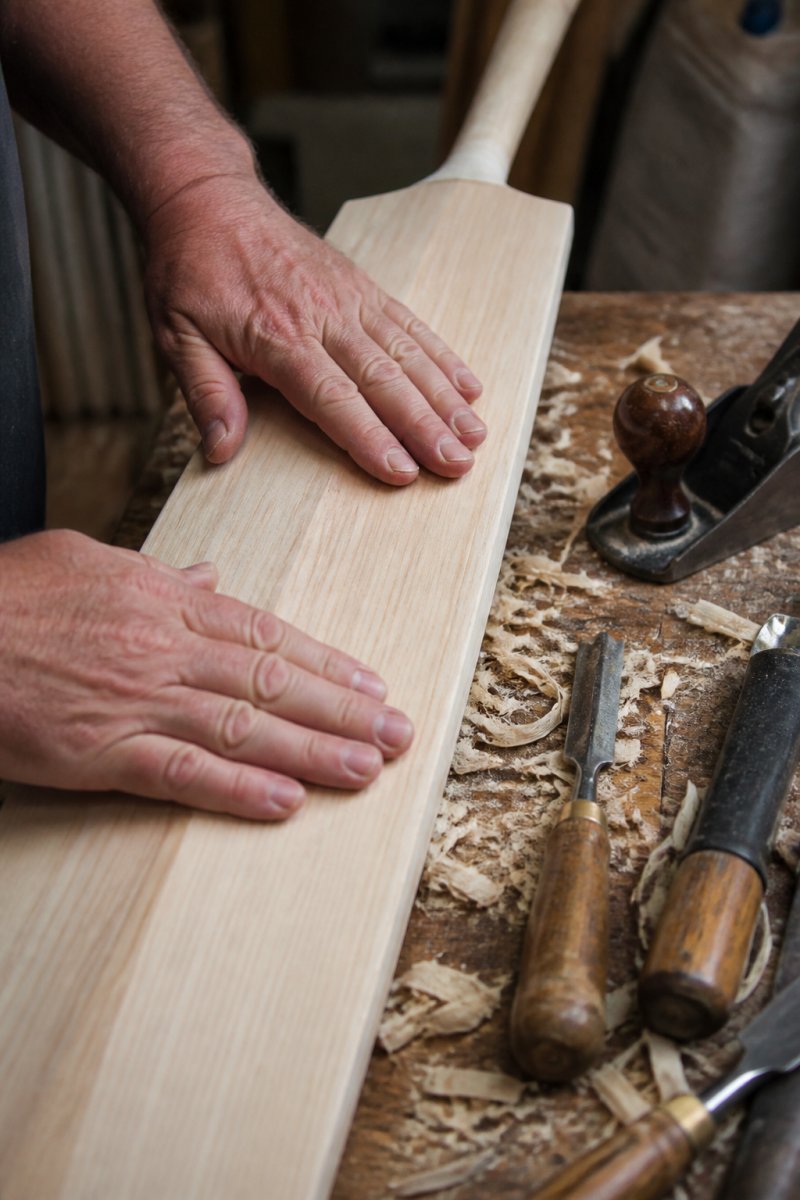
Here is how the practical tiers break down at club level:
| Grade | Typical Appearance | Performance Reality | Best For |
|---|---|---|---|
| Grade 1 | 8-12+ straight grains, clean face | Best potential, but varies cleft to cleft | Elite club and representative players |
| Grade 2 | Fewer grains, minor stains | Pressed and shaped identically when selected on ping | Club players who value performance over looks |
| Grade 3+ | Visible blemishes, colour variation | Playable, less consistent response | Social and lower-grade cricket |
The key insight: pressing, handle construction and balance decide how a bat plays. A Grade 2 cleft selected on ping can outperform a Grade 1 cleft selected on looks. That is the entire premise behind the Performance Edition, which uses premium Grade 2 willow chosen for response rather than appearance.
How SGM Selects Willow on Ping, Not Looks
Every SGM Cricket Bats cleft is assessed by sound and feel before it becomes a bat. Clefts that ring cleanly and feel dense under the mallet move forward regardless of how many grains sit on the face. Those with stains or fewer grains but genuine response become Performance Edition bats. The ones with both clean grain and strong ping become Players Grade, Reserve Edition or custom builds.

This is where most buying guides fall short. They rank willow by photograph. We rank it by how it behaves when the ball hits the middle.
English Willow vs Kashmir Willow for Club Cricket
English willow is the standard for performance cricket because of its low density and high spring, which produce a lighter pick-up and faster ball speed off the face. Kashmir willow is denser and heavier, more affordable, and suited to beginners and casual play rather than competitive club cricket.
The trade-off is straightforward. Kashmir willow bats cost less and last a long time, but they feel heavier for the same size and offer less rebound. English willow bats cost more and reward proper preparation, but they give you the ping that turns a good shot into a boundary.
For a club player training twice a week and playing Saturdays, English willow is worth the investment. For a junior just learning the game, Kashmir willow makes sense until technique and strength develop. SGM Cricket Bats does not stock junior bats as shelf items. Junior bats are made to order, sized and weighted to the individual player, which matters more at that age than any grade label.
Choosing the Right Willow Grade for Your Game
Match the grade to your level and your budget, not to the label on the sticker. A Grade 2 bat selected on ping will serve a club player better than a Grade 1 bat bought purely for its grain count. Spend on response, not cosmetics.
Three questions decide it:
- How often do you play? Weekly club cricket with midweek training justifies Players Grade or Reserve Edition willow.
- What is your technique? Stroke players who rely on timing benefit from a lighter pick-up. Power hitters can carry more mass.
- What is your budget? Fixed pricing means you know exactly what you are paying before you commit.
For most club cricketers, the Players Grade at $699.00 is the sweet spot. It uses Grade 1 English willow, the same grade seen in first-class cricket, and comes in weights from 2.6 to 2.12 lbs. If you want a minimum of 8 to 10 grains on the face, the Reserve Edition at $799.00 adds that selection on top.
Players Grade English Willow Cricket →

Weight, Profile and Balance for Club Conditions
Club pitches are rarely Test-standard. They can be slow, low, or two-paced, and that changes what you need from a bat. A lighter bat gets through the ball faster on slow decks. A heavier bat helps on true, quick surfaces where you can hit through the line.
Profile matters just as much. The SS Duck Bill Profile concentrates mass lower for enhanced control, which suits players who work the ball into gaps. The Full Profile keeps mass higher for powerful hitting through the line. Neither is better in isolation. It depends on how you score.
Balance is the spec nobody talks about and everybody feels.
How to Knock In a Cricket Bat Before Match Play
Knocking in is the process of compressing the willow fibres with repeated strikes so the bat face hardens gradually and resists cracking. Skip it and you risk a cracked toe or split edge within the first few net sessions.
A practical sequence:
- Start with a mallet, not a ball, for the first two sessions
- Work the face, edges and toe in short, controlled strikes
- Move to throw-downs at half pace, then three-quarter pace
- Reserve full-pace bowling and new-ball work for after the bat has darkened
- Give it roughly six to eight hours of total preparation before match use
Custom-Made English Willow Bats: What to Specify
A custom build lets you control weight, profile, grip and willow grade, then have the bat made to those numbers rather than accepting whatever the shelf offers. SGM Cricket Bats handcrafts custom bats to order, with a three-week turnaround from the day you choose your willow.

The specifications worth deciding before you order:
- Weight: 2.5 to 2.12 lbs covers most club players
- Profile: SS Duck Bill for control, Full Profile for power
- Grip: thickness and texture, based on hand size and glove preference
- Willow grade: Performance, Players or Reserve, depending on budget and level
Common Mistakes When Buying English Willow
Buying on grain count alone is the mistake that costs club players the most money. A clean face tells you nothing about density, pressing or balance, and those three things decide how the bat performs.
Other errors worth avoiding:
- Ignoring pick-up. A bat that feels heavy in the shop will feel heavier in the fifteenth over.
- Skipping knocking in. Covered above, and still the most common cause of early breakage.
- Buying for the badge. A recognised name on the sticker does not guarantee the cleft was selected well.
- Over-buying for your level. A social player does not need a Reserve Edition bat. Spend that money on coaching or a second net session.
- Not asking about the handle. The handle takes the shock. A one-year warranty on the handle only is standard, and it is the part most likely to need attention first.
Frequently Asked Questions
What are the different grades of English willow used in cricket bats?
English willow is graded largely on grain count and appearance. Grade 1 has the straightest, most even grains and is used at first-class and international level. Grade 2 may show fewer grains or minor colour variation but can perform just as well. Grades 3 and 4 have more visible blemishes. At SGM, the Performance Edition uses Grade 2 willow selected on ping, the Players Grade uses Grade 1, and the Reserve Edition requires a minimum of 8 to 10 grains.
Does the number of grains on a cricket bat affect performance?
Grain count is a visual indicator of willow quality, not a guarantee of performance. A bat with 10 straight grains can still feel dead if the pressing, handle construction or balance is poor. The factors that decide how a bat plays are the pressing, the density and quality of the willow, the handle, and the shape and profile. SGM selects bats on ping performance rather than cosmetics, so a bat with fewer grains can still be a top performer.
Why is English willow preferred over Kashmir willow for club cricket?
English willow (Salix alba caerulea) is lighter, softer and more responsive than Kashmir willow, which is denser and heavier. That lower density lets bat makers press English willow to produce a livelier surface with a bigger sweet spot, so the ball travels further for the same effort. Kashmir willow suits tennis-ball and lower-intensity cricket, but for hard-ball club cricket, English willow gives better balance, faster bat speed and a longer peak performance window.
How should I prepare my new English willow bat for match play?
Every new English willow bat needs knocking in before use. Start with a mallet or old ball and work systematically over the face, edges and toe for several hours across multiple sessions, gradually increasing force. Pay extra attention to the edges and toe, which are the most vulnerable areas. SGM bats are machine-knocked 15,000 times before delivery, but you should still complete a light hand-knocking routine and face a few throwdowns before using it in a match.


