

Table of Contents
- What Makes the Best Cricket Bat for Power
- Reserve Edition: Premium Grain for Elite Power Hitters
- Players Grade: Technique-Driven Power Through Superior Bat Speed
- Performance Grade: Power Without the Premium Price
- Cricket Bat Weight Guide for Power Hitters
- English Willow vs Kashmir Willow for Power
- Cricket Bat Sweet Spot Explained: Why Location Matters for Power
- How to Choose Your Power Bat: Custom vs Ready-Made
- Frequently Asked Questions
Last Updated: September 3, 2026
What Makes the Best Cricket Bat for Power
The best cricket bat for power isn't determined by grain count or cosmetic appearance, it's built on three foundations: willow density, weight distribution, and sweet spot location. At SGM Cricket Bats, we've handcrafted thousands of bats, and the difference between a bat that generates genuine power and one that merely looks premium comes down to how the wood is pressed, shaped, and balanced.

Power hitters often assume heavier bats generate more force, but a poorly balanced 2.12 lbs bat exhausts your arms and slows your swing. A precisely weighted 2.6 lbs bat with optimal balance point accelerates through the ball with less effort, transferring energy more efficiently (peer-reviewed research on bat energy transfer).
The sweet spot, where impact generates maximum velocity with minimum vibration, determines how much swing speed translates into runs. A sweet spot positioned too high or too low will feel dead even when struck cleanly, as location dictates rebound coefficient and impact force distribution.
Selecting a power bat means choosing three variables: willow grade (density and consistency), weight profile (swing speed and control), and profile shape (sweet spot location).
Reserve Edition: Premium Grain for Elite Power Hitters
The Reserve Edition English Willow Cricket Bat represents the pinnacle of willow selection, with a minimum of 8 to 10 grains running through the blade. For power hitters who demand elite performance, this grade delivers the consistency and durability required at representative and international levels.
Premium grain selection matters because tighter grain structure indicates denser wood that compresses more effectively during manufacturing, creating a larger sweet spot and improved rebound (research on wood density and cricket bat performance). The Reserve Edition's rigorous specification means every bat meets a verifiable standard.
This grade suits experienced club cricketers who want equipment that won't fail under pressure. Thicker edges provide a larger sweet spot without compromising balance.
The Reserve Edition costs $799.00 with customisation to your exact weight and profile. Handcrafted and ready within three weeks, each bat is machine-knocked 15,000 times before delivery. The 1-year handle warranty covers manufacturing defects.
Feature |
Reserve Edition |
Performance Grade |
|
|---|---|---|---|
Grain Count |
8-10 minimum |
Grade 1 |
Grade 2 |
Weight Range |
2.5-2.12 lbs |
2.6-2.12 lbs |
2.5-2.12 lbs |
Sweet Spot Size |
Larger |
Large |
Medium-Large |
Price |
$799.00 |
$699.00 |
$599.00 |
Best For |
Elite players |
Technique-focused |
Value-conscious power |
Players Grade: Technique-Driven Power Through Superior Bat Speed
The Players Grade is built for cricketers whose runs come from timing and placement rather than brute force. It uses Grade 1 English willow (first-class and international standard) but prioritises lighter mass to unlock natural bat speed.

The lighter weight (2.6 to 2.12 lbs) means timing does the work instead of arm strength. A technically refined batter swinging a lighter bat generates more velocity through the hitting zone than a raw power hitter with a heavier bat. The bat accelerates faster, widening the contact window and converting defensive edges into runs.
This grade suits opening batters, players advised their bat is too heavy, and technically sound representative-level batters. Female cricketers and shorter players benefit from the full-size blade at lighter weight, eliminating arm fatigue.
The Players Grade is available at $699.00 in SS Duck Bill (control for late cuts) or Full Profile (larger sweet spot). Customisation is standard, specify your exact weight and the bat is handcrafted to match.
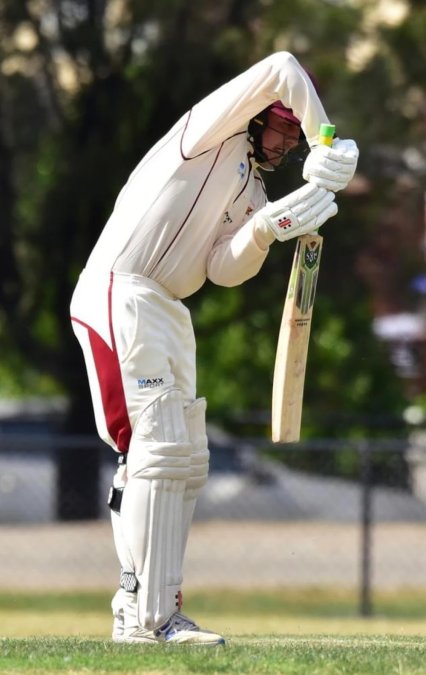
Professional cricketer in batting stance at the crease showing proper hand position and bat alignment during a power shot, with focus on contact point and body positioning
Performance Grade: Power Without the Premium Price
The Performance Grade challenges traditional grading by selecting on ping performance, how the bat plays, rather than grain count and cosmetic appearance.

This grade uses Grade 2 English willow with possible cosmetic variations (fewer grains, minor stains, colour variation) that don't affect performance. A Performance Grade bat pressed and shaped to Reserve Edition specifications performs identically at the crease but costs $599.00 instead of $799.00.
For power hitters, value lives here, you pay for performance, not visual perfection. Thicker edges provide a larger sweet spot; full profile options deliver power generation. Available 2.5 to 2.12 lbs, it suits batters who prioritise runs over appearances.
Customisation and knocking-in service are available. Handcrafted in Melbourne and ready within three weeks, each bat includes free delivery within Australia on orders over $150.
Cricket Bat Weight Guide for Power Hitters
Bat weight directly affects swing speed, timing window, and power generation. Heavier bats transfer more momentum but require faster arm speed; lighter bats accelerate faster but demand precise timing.
For power hitters, the optimal range is 2.3 to 2.12 lbs, allowing peak velocity with control. Heavier than 2.3 lbs compresses your backlift under pressure; lighter than 2.12 lbs sacrifices momentum transfer.
Your height, arm length, and batting style determine ideal weight. Taller players often prefer 2.3 to 2.25 lbs; shorter players and faster hands typically prefer 2.18 to 2.12 lbs. Test multiple weights in match conditions, nets feel different under pressure.
SGM Cricket Bats lets you specify exact weight during customisation. If unsure, start at the heavier end and adjust downward if rushing shots, it's easier to adapt to lighter than to regain speed.
Weight |
Best For |
Swing Speed |
Power Potential |
Control |
|---|---|---|---|---|
2.3-2.25 lbs |
Tall players, slower hand speed |
Moderate |
High |
Excellent |
2.18-2.12 lbs |
Shorter players, quick hands |
High |
Moderate-High |
Good |
Below 2.12 lbs |
Juniors, female players |
Very High |
Moderate |
Fair |
English Willow vs Kashmir Willow for Power
English willow and Kashmir willow are fundamentally different woods, and the choice determines your bat's performance ceiling and durability.
English willow grows in England's temperate climate, producing denser wood with tighter grain structure (USDA Forest Service research on wood properties). This density creates superior rebound, a larger sweet spot, and greater durability. English willow bats maintain performance over thousands of overs but command a premium due to rarity and rigorous manufacturing.
Kashmir willow grows in the Himalayas and produces lighter, less dense wood. It's cheaper to source, making bats significantly less expensive, but the wood fatigues faster and loses ping after 500-800 overs. For recreational or junior cricket, it offers acceptable performance at lower cost.
For power hitters, English willow is the only serious choice. Power generates impact stress Kashmir willow cannot sustain. For multi-season use at representative level, English willow's durability and rebound are non-negotiable; additional cost is offset by lifespan and consistency.
SGM Cricket Bats exclusively uses English willow because power hitters deserve equipment that won't compromise mid-season. The Reserve Edition, Players Grade, and Performance Grade are all crafted from English willow selected for density and performance.
Cricket Bat Sweet Spot Explained: Why Location Matters for Power
The sweet spot is where impact generates maximum velocity with minimum vibration. Its location is determined by weight distribution, profile shape, and willow density.
For power hitters, sweet spot location dictates margin for error. Too high forces perfect length; too low requires hitting through rather than across. Optimal positioning (typically in the lower-middle section of the blade) generates power across deliveries without losing bat speed.
Sweet spot size matters too. Thicker edges create a larger sweet spot by providing more wood to absorb and redirect impact energy. Pronounced edges are functional, not cosmetic, they let you hit hard even with slightly off timing.
Different profiles position the sweet spot differently. Full Profile (traditional) positions it lower, suiting aggressive drivers. SS Duck Bill positions it higher, favouring control and late-hitting. Match your natural hitting zone to the profile that maximises sweet spot utilisation.
How to Choose Your Power Bat: Custom vs Ready-Made
The choice between custom and ready-made depends on timeline, budget, and how precisely you know your specifications.
Ready-made bats are available immediately and cost less. You can inspect willow, feel balance, and test the sweet spot. However, they're compromises, weight might be off, profile may not match your style, and you're limited to manufacturer stock.
Custom bats take three weeks but deliver exact requirements. Specify weight to 0.05 lbs, choose profile, select willow grade, and work with the craftsperson to match balance to your swing. For serious power hitters, custom is worth the wait.
SGM Cricket Bats offers both options. Custom service starts at $699.00 with a configurator for willow grade, size, weight, and profile. Handcrafted in Melbourne and ready within three weeks, each bat is machine-knocked 15,000 times before shipment.
For immediate delivery: Performance Grade at $599.00 (ping-selected ready-made), Players Grade at $699.00 (Grade 1 willow, ready-made or custom), or Reserve Edition at $799.00 (premium grain for elite players).
Timeline matters most. Eight weeks allows custom; next weekend requires ready-made. Either way, SGM Cricket Bats delivers handcrafted English willow bats built for power, balance, and performance.
Choosing the best cricket bat for power requires understanding three elements: the willow grade (which affects density and durability), the weight profile (which determines swing speed and control), and the sweet spot location (which dictates your margin for error). SGM Cricket Bats specialises in handcrafted English willow bats tailored to individual player preferences, offering custom configurations and three grade levels to suit every standard from club to international cricket. Whether you prioritise premium grain selection, technique-driven lighter weight, or performance value, SGM Cricket Bats delivers bats built for power, balance, and reliability. Shop now and discover why serious power hitters trust handcrafted English willow over mass-produced alternatives.
Frequently Asked Questions
What makes a cricket bat good for power hitting?
A power bat combines three elements: premium English willow that's dense and responsive, a full profile that maximises the sweet spot, and the right weight balance for your strength and technique. The best cricket bat for power delivers a sweet spot positioned in the lower-middle of the blade, thicker edges that generate more force on impact, and a construction method—like handcrafting—that ensures consistent performance across repeated strikes. Grain count matters less than the wood's actual density and pressing quality.
Does a heavier cricket bat provide more power?
Not necessarily. A heavier bat adds momentum but slows your swing speed, which can actually reduce power if you're not strong enough to accelerate it through the hitting zone. The ideal weight depends on your strength, technique, and playing style. Power hitters who rely on timing and placement often perform better with a lighter bat (2.6 lbs) that allows faster bat speed, whilst players who generate power through muscle can use a standard weight (2.7–2.8 lbs). The key is finding the weight that lets you maintain control and acceleration through the ball.
What is the best willow grade for a power-hitting bat?
English willow is superior to Kashmir willow for power. Within English willow, the Reserve Edition (minimum 8–10 grains) delivers the highest performance for elite players, whilst the Players Grade and Performance Grade offer excellent power at lower price points. Reserve Edition bats cost $799, Players Grade $699, and Performance Grade $599. For most club cricketers, Players Grade or Performance Grade provides genuine power without the premium cost of Reserve Edition. The difference is reliability and consistency rather than raw power potential.
How does bat profile affect power generation?
Bat profile determines the size and location of the sweet spot. A full profile creates a larger sweet spot across the middle of the blade, ideal for power hitters who want forgiveness on off-centre strikes. The SS Duck Bill profile concentrates the sweet spot lower and offers enhanced control for technical players. For pure power, a full profile maximises the hitting area and transfers more energy to the ball. Choose full profile if power is your priority; select SS Duck Bill if you value precision and control alongside power.
Are custom-made bats better for power hitters?
Custom bats allow you to specify exact weight, profile, and balance point to match your strength and technique, which can unlock more consistent power than off-the-shelf options. SGM's custom bats are handcrafted to your requirements and ready in 3 weeks, starting at $699. However, a quality ready-made bat like the Players Grade or Reserve Edition will deliver genuine power immediately. Custom bats excel when you know your exact specifications; they're worth the wait if you've struggled to find the right balance in mass-produced options.


