

Table of Contents
- Why Handcrafted English Willow Bats Outperform Factory-Made Options
- English Willow vs Kashmir Willow Performance: What the Data Shows
- Cricket Bat Cleft Grading Explained: Players, Reserve and Performance Grades
- The Craft Behind Handcrafted English Willow Bats: From Cleft to Crease
- How to Maintain an English Willow Cricket Bat Through the Season
- Choosing the Right Handcrafted Bat: Weight, Balance and Custom Profiles
- Conclusion: Why Handcrafted English Willow Bats Are Worth the Investment
- Frequently Asked Questions
Last Updated: September 14, 2026
Why Handcrafted English Willow Bats Outperform Factory-Made Options
A handcrafted English willow bat is a cricket bat shaped, pressed and finished by hand from a single selected willow cleft, rather than turned out on a production line to a fixed template. The difference shows up in the ping, the balance point and how long the bat holds its performance. This guide from SGM Cricket Bats covers what separates the two, how grading works, and how to choose and care for a bat that lasts.
Factory bats are built to a specification. Handcrafted bats are built to a player.
That distinction matters more than most club cricketers realise. A mass-produced bat is pressed to an average, finished to a weight bracket, and shipped. A handcrafted bat is assessed cleft by cleft, shaped around how you actually bat, and finished by someone who has felt hundreds of bats come off the plane.
Below, we'll show you exactly how the craft process works, what the grades mean, and how to get years of performance out of a single bat.
English Willow vs Kashmir Willow Performance: What the Data Shows
English willow outperforms Kashmir willow for one structural reason: its fibres are longer, straighter and more uniformly aligned, so the wood compresses and rebounds more cleanly on impact (pubmed.ncbi.nlm.nih.gov). Kashmir willow is denser and heavier, which makes it more affordable but less responsive.
In practice, this means an English willow bat transfers more of your energy back into the ball. Kashmir willow absorbs more of it.
The trade-offs look like this:
| Attribute | English Willow | Kashmir Willow |
|---|---|---|
| Fibre structure | Long, straight, springy | Shorter, denser |
| Ping off the face | High, rebounds fast | Muted, absorbs energy |
| Weight for size | Lighter for same profile | Heavier |
| Break-in period | Needs knocking in | Shorter break-in |
| Typical use | Club, representative, professional | Entry level, synthetic balls |
A common mistake is buying a Kashmir willow bat for hard-ball cricket because it feels solid in the shop. It will feel solid. It just won't ping the way English willow does once you're facing pace.
Cricket Bat Cleft Grading Explained: Players, Reserve and Performance Grades
Cleft grading describes the quality of the willow before it becomes a bat, based on grain count, straightness, blemish level and fibre integrity. The three grades that matter most to club and representative players are Players, Reserve and Performance.
Here's what separates them:
- Players Grade: Clean, straight grains with minimal blemish. Selected for players who want maximum responsiveness and are prepared to knock the bat in properly.
- Reserve Grade: The top of the range. A minimum of 8 to 10 straight grains, the finest willow available, reserved for serious cricketers chasing the highest level of performance.
- Performance Grade: Selected on ping rather than appearance. Grain count and cosmetic blemishes are deliberately ignored, because they don't determine how a bat plays.
That last point is where most buyers get it wrong. A bat with a beautiful 12-grain face but a dead response is a worse cricket bat than a plainer one that sings. SGM Cricket Bats selects Performance Grade bats specifically on ping for exactly this reason.

The Craft Behind Handcrafted English Willow Bats: From Cleft to Crease
The craft process runs from cleft selection through shaping, pressing, handle fitting, shaping to profile, and final hand-finishing. Each stage is done by hand because each cleft behaves differently, and a machine can't feel that.
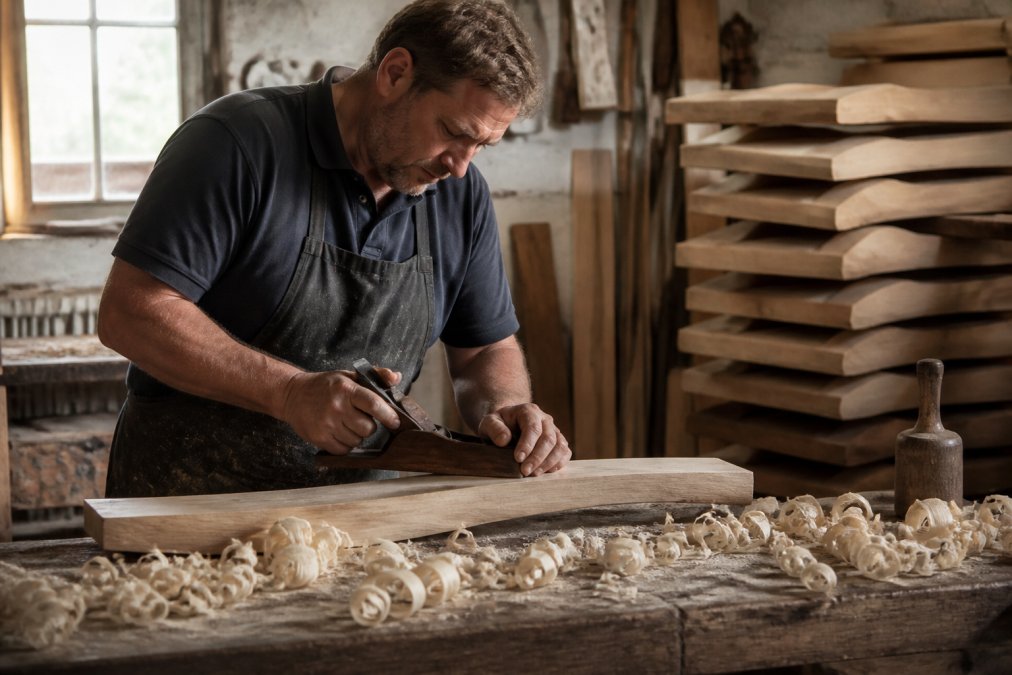
It starts with the cleft. Willow is split, not sawn, so the fibres run true down the blade (pubmed.ncbi.nlm.nih.gov). A sawn cleft cuts across fibres and creates weak points. Splitting preserves the natural grain and gives the bat its rebound.
From there, the bat is pressed in stages. Too much pressing deadens the willow (pubmed.ncbi.nlm.nih.gov). Too little and it won't survive a hard ball. An experienced maker reads the wood and adjusts pressure cleft by cleft.
The handle is then fitted, glued and shaped. This is where balance is decided. A slightly heavier handle can shift the pick-up entirely, which is why two bats of identical weight can feel completely different in your hands.
Finally, the bat is shaped to profile, sanded, and finished by hand. SGM Cricket Bats manages this entire process in its own factory, from cleft selection through to final inspection, which is how a custom profile can be built to a specific player's specs rather than pulled from a rack.

How to Maintain an English Willow Cricket Bat Through the Season
Maintaining an English willow cricket bat comes down to three things: a proper break-in, consistent oiling, and protecting it from moisture. Get those right and a good bat will hold its performance for years.
The break-in (knocking in):
- Start with a mallet, working gradually from the centre outward
- Spend longer on the edges and the toe, which take the most punishment
- Build up over several sessions rather than one long one
- Move to throw-downs before facing pace
Oiling:
- Apply a light coat of raw linseed oil to the face, edges and toe
- Wipe off any excess after it soaks in
- Do this sparingly, once or twice before the season starts
Storage and protection:
- Keep the bat out of extreme heat and damp
- Use a toe guard and an anti-scuff sheet
- Never leave it in a hot car or a wet kit bag
Choosing the Right Handcrafted Bat: Weight, Balance and Custom Profiles
Weight is the number most players fixate on, but balance is what actually determines how a bat feels in the middle. A 2lb 9oz bat with a low balance point will feel heavier to pick up than a 2lb 11oz with the weight distributed higher.
When choosing, work through this in order:
- Pick-up first. Swing the bat in the shop or, for custom orders, describe your current bat and what you'd change.
- Match weight to your game. Stroke players generally favour lighter bats for bat speed. Power hitters often prefer more mass through the middle.
- Consider the profile. A fuller profile gives a bigger sweet spot. A thinner profile suits players who hit through the line.
- Think about the handle. Oval or round, and the thickness, changes how the bat sits in your grip.
- Account for the break-in. A bat that feels slightly stiff now will loosen up after knocking in.
A custom-made bat lets you set willow grade, size, weight and profile to your own specs, which is the main advantage over an off-the-shelf option. SGM Cricket Bats builds custom bats to order and typically has them ready within three weeks from the day you choose your willow.
Conclusion: Why Handcrafted English Willow Bats Are Worth the Investment
The gap between a factory bat and a handcrafted one isn't cosmetic. It's in the pressing, the handle fitting, the cleft selection, and the fact that someone shaped the bat around how you play rather than around a weight bracket. That's what you're paying for, and at club and representative level it shows up in your timing, your bat speed, and how long the bat stays alive.
If you're weighing up whether to go custom, the answer usually comes down to how seriously you're playing and how long you want the bat to last. SGM Cricket Bats offers handcrafted English willow bats across Players, Reserve and Performance grades, custom profiles built to your specs, and a bat repair and re-handling service to extend the life of a bat you already love.
Get started with SGM Cricket Bats and get a bat built around your game, not a production line average.
Frequently Asked Questions
What makes English willow superior to other wood types for cricket bats?
English willow (Salix alba caerulea) has a fibrous, cellular structure that absorbs ball impact without cracking, which is why it delivers a distinctive ping. Kashmir willow is denser and heavier, so it feels dead off the face and loses performance faster. Handcrafted English willow bats also hold their shape longer because the willow is pressed and shaped to work with the grain rather than against it.
How does the handcrafted process improve bat performance?
A handcrafted bat lets the maker match the cleft to the player's weight, balance and profile preferences. The willow is pressed in stages, the spine and edges are shaped by hand, and the handle is fitted to suit the batter's grip. This produces a bat that feels lighter than its scale weight and transfers more energy into the ball. Factory-made bats are shaped to a generic template, so they rarely suit an individual's game.
What is the difference between English willow and Kashmir willow?
English willow is grown in cooler, wetter conditions, giving it a wider grain and a softer, springier fibre. Kashmir willow is grown in warmer climates, producing a harder, denser timber that is cheaper but offers less ping. English willow bats cost more because the trees take 15 to 25 years to mature and only a portion of each trunk is suitable for a cleft. Kashmir willow bats are fine for beginners, but serious players notice the difference immediately.
How do I identify a high-quality handcrafted cricket bat?
Look for straight, evenly spaced grains on the face (8 to 12 is a good sign), a clean, knot-free surface, and a handle that feels firm with no creaking when you twist it. Tap the face with a mallet or your knuckle and listen for a sharp, high-pitched ping rather than a dull thud. Ask the maker about the cleft's origin and grading. A bat with a clear grain pattern and a lively ping will serve you better than one with a fancy sticker.
Does the weight of an English willow bat affect swing speed?
Yes. A lighter bat (around 1.1 to 1.2 kg) lets you swing faster and time the ball later, which suits stroke players. A heavier bat (1.25 to 1.35 kg) generates more power if you have the strength to control it. Handcrafted bats are often picked up lighter than their actual weight because the balance point is closer to the handle. SGM's Players Grade, for example, is built for players who rely on bat speed and timing over brute force.
Why is cleft selection critical in professional-grade bat making?
The cleft is the piece of willow that becomes the blade. Its grain structure, moisture content and density determine how the bat performs after pressing. A cleft with straight, tight grains and no hidden knots will ping harder and last longer. At SGM, every cleft is inspected before shaping, and the best ones go into Reserve Edition bats with a minimum of 8 to 10 grains. Poor cleft selection is the main reason cheap bats go dead within a season.


