

Table of Contents
- Badger vs Boundary Cricket Bats: Quick Comparison
- Badger Cricket Bats: Pros and Cons
- Boundary Cricket Bats: Pros and Cons
- English Willow Cricket Bat Grades and What They Mean for Performance
- How to Choose the Right Cricket Bat Weight
- Benefits of Custom-Made Cricket Bats
- Which Bat Suits Your Game? Badger, Boundary or Custom
- Conclusion
- Frequently Asked Questions
Last Updated: September 21, 2026
Badger vs Boundary Cricket Bats: Quick Comparison
Badger and Boundary cricket bats sit at opposite ends of the market, and the gap between them matters more than most buyers realise. This comparison from SGM Cricket Bats looks at how each brand approaches willow selection, weight distribution, and finish, so you can judge which one actually suits your game. Below, we break down the strengths, the trade-offs, and the point where a custom build starts to make more sense than either.

The badger vs boundary cricket bats debate usually comes down to one question: do you want a bat that plays a certain way out of the box, or one shaped around how you actually bat? Badger bats tend to favour a traditional, balanced feel. Boundary bats lean toward a punchier middle and a more aggressive profile.
Neither approach is wrong. They just suit different players.
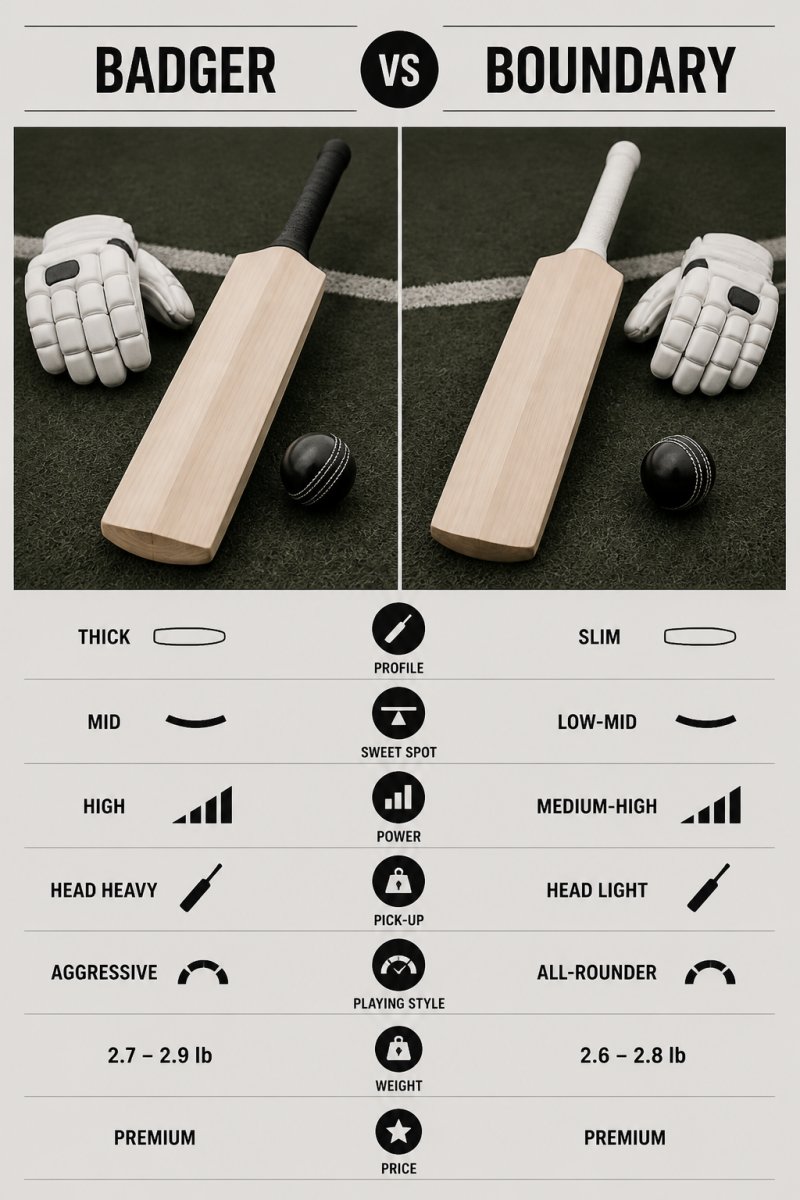
| Feature | Badger | Boundary | SGM Custom |
|---|---|---|---|
| Willow focus | Traditional grading | Performance-first selection | Selected on ping |
| Weight range | Standard retail weights | Mid to heavy options | 2.5 to 2.12 lbs |
| Profile choice | Limited stock shapes | Fixed models | SS Duck Bill or Full |
| Lead time | Off the shelf | Off the shelf | Made to order, 3 weeks |
| Best for | Club regulars | Power hitters | Players wanting a tailored fit |
Badger Cricket Bats: Pros and Cons
Badger bats appeal to players who want a dependable, familiar feel without a long wait. The brand has built a following on classic shapes and consistent pickup, and for many club cricketers that predictability is the whole point. You know roughly what you are getting before it arrives.
Pros:
- Traditional balance suits players who time the ball rather than swing hard
- Widely available, so you can often try before buying
- Familiar shapes reduce the adjustment period
Cons:
- Limited customisation, so weight and profile are largely fixed
- Grain quality varies between individual bats in the same model
- No control over the pressing or handle build
The catch is that two Badger bats of the same model can feel different. Willow is a natural material, and mass-produced bats are graded in batches rather than individually. If you have ever picked up a bat that felt dead compared to its twin on the shelf, you have met this problem.
Boundary Cricket Bats: Pros and Cons
Boundary bats are built for players who want the ball to travel. The profiles tend to carry more wood low in the blade, which pushes the sweet spot down and rewards front-foot hitting. If your game is built on clearing the infield, that shape does a lot of the work for you.
Pros:
- Lower sweet spot generates power with less effort
- Thicker edges create a larger hitting zone
- Suits aggressive, front-foot batting styles
Cons:
- Heavier pickup can tire you out over a long innings
- Less forgiving for late players facing early movement
- Fixed profiles leave little room to adjust balance
The trade-off is control. A bat with more mass low in the blade takes more effort to manoeuvre, and players who rely on soft hands and late cuts often find it slows their backlift under pressure. That is not a flaw in the bat. It is a mismatch between the bat and the batter.
English Willow Cricket Bat Grades and What They Mean for Performance
English willow cricket bat grades describe the visual quality of the wood, not how well the bat will perform. Grade 1 willow has straighter grain and fewer blemishes, while lower grades show more colour variation and wider grain spacing. That is the whole story the traditional system tells.
Here is what most buyers get wrong: grain count and clean looks do not guarantee ping. Performance comes from the density of the cleft, the pressing, the handle construction, and the shape. A bat with eight straight grains can play worse than a bat with a few stains if the pressing is wrong. At SGM Cricket Bats, we select clefts on ping performance rather than cosmetics, because a clean face does not put runs on the board.
How to Choose the Right Cricket Bat Weight
How to choose the right cricket bat weight comes down to one test: can you play a full range of shots without your backlift shortening under pressure? A bat that feels light in the shop can feel heavy at the crease in the twentieth over. A bat that feels heavy on the shelf might be exactly right once you are set.
Players Grade English Willow Cricket →

Most adult bats sit between 2.6 and 2.12 lbs. Lighter bats, around 2.6 to 2.8, suit players who time the ball and play late. Heavier bats, from 2.10 upward, give power hitters more mass to work with. There is no universally correct weight, only the weight that matches your technique and your strength.
- Stroke players and openers: lean lighter, around 2.6 to 2.8 lbs
- Front-foot power hitters: 2.10 to 2.12 lbs
- Shorter players and female cricketers: lighter blades reduce arm fatigue
- Anyone told their bat is too heavy: drop down and feel the difference
Benefits of Custom-Made Cricket Bats
Benefits of custom-made cricket bats start with fit. A custom build lets you set the weight, profile, handle shape, and grip so the bat matches your game instead of asking you to adapt to it. That matters most for players who have never quite found an off-the-shelf bat that felt right.
The process at SGM Cricket Bats works through a configurator: you choose your willow grade, size, weight, and any deeper specifications, and the bat is handcrafted and ready within three weeks. Each bat is machine-knocked 15,000 times before delivery, and the handle carries a one-year warranty. The MCC Laws of Cricket set the size and dimension limits every bat must meet, so a custom build stays fully match-legal.
Custom bats also solve the durability question. When one workshop controls cleft selection, pressing, and handle fitting, the bat is built as a single unit rather than assembled from parts sourced separately. Re-handling and repair services extend that life further when the handle eventually softens.
Which Bat Suits Your Game? Badger, Boundary or Custom
The right bat depends on how you score runs, not on which brand is trending. Badger suits the club regular who wants a predictable, traditional bat off the shelf. Boundary suits the front-foot hitter chasing power. A custom build suits the player who has outgrown both.
Here is the honest split:
- Choose Badger if you want a familiar feel, a quick purchase, and you are happy with a stock shape.
- Choose Boundary if your game is built on clearing the infield and you want a lower sweet spot.
- Choose custom if you have ever felt an off-the-shelf bat was almost right, or if your weight and profile needs fall outside what retail models offer.
For most players reading this, the deciding factor is fit.
Conclusion
Finding a bat that matches your technique is harder than it should be, because most retail options ask you to compromise on weight, profile, or both. SGM Cricket Bats builds bats around the player instead, using expert willow selection, a configurator that lets you set weight and profile, and handcrafted construction ready in three weeks. Get started with SGM Cricket Bats and bat with equipment shaped to your game, not the other way around.
Frequently Asked Questions
What are the main differences between Badger and Boundary cricket bats?
The differences come down to willow grade, weight distribution and profile. Badger bats typically favour a mid-to-low sweet spot for front-foot players, while Boundary bats often suit back-foot stroke makers. Weight range, handle shape and grain count vary by model. When comparing badger vs boundary, check the exact specs of each bat rather than the brand name alone, because both makers offer multiple grades.
How does English willow quality affect how a bat performs?
English willow cricket bat grades reflect grain count, colour and cosmetic appearance. Grade 1 willow, with 8 to 10 straight grains, is used at first-class and international level. But grading is cosmetic: pressing, handle construction, willow density and balance determine how a bat actually plays. A Grade 2 bat selected on ping can outperform a prettier Grade 1 bat that was pressed poorly.
Should I choose a bat based on its profile or its weight?
Start with weight, then match the profile to your game. A bat that is too heavy shortens your backlift and costs you timing, especially against pace. Once the weight feels right, choose a profile: a full profile for power hitting, or an SS Duck Bill profile for control and a lower sweet spot. Knowing how to choose the right cricket bat weight matters more than any cosmetic feature.
Are custom-made cricket bats better than off-the-shelf options?
Custom bats let you set weight, profile and grip to your exact requirements, which off-the-shelf bats cannot. The benefits of custom-made cricket bats include better balance for your technique, a weight verified before delivery, and a handle matched to how you hold the bat. For club and representative players, that fit often translates into more consistent timing and fewer arm-fatigue issues.
How do I maintain my cricket bat so it lasts longer?
Knock in your bat properly before use, oil the face sparingly in the off-season, and avoid facing new-ball bowling in the nets until the edges and toe are prepared. Store it away from extreme heat and damp. If a crack or splice issue appears, a professional repair and re-handle service can extend the bat's life instead of forcing a replacement.


