

Table of Contents
- What Bat Profile Actually Means for Fast Bowling
- High, Mid, and Low Profile Bats Compared
- Cricket Bat Sweet Spot Position and How It Changes Against Pace
- The Physics of Ball-on-Bat Impact at High Velocity
- Best Cricket Bat Weight for Fast Bowling
- How Pitch Conditions Should Shape Your Bat Profile Choice
- Spine Height, Edge Thickness, and the Role of the Cleft
- Drill-Based Testing: How to Confirm Your Bat Profile Works for You
- Maintenance and Its Impact on Profile Performance Over Time
- Custom Cricket Bat Delivery Time and What to Expect
- Frequently Asked Questions
Last Updated: August 31, 2026
Choosing bat profile for fast bowlers is one of the most consequential decisions a cricketer makes, yet most players approach it based on aesthetics or brand loyalty rather than how they actually play against pace. At SGM Cricket Bats, we've built hundreds of custom English willow bats for players across every level, and the single most common mistake we see is selecting a profile without understanding how it affects your natural game. The profile of your bat determines where the sweet spot sits, how the bat responds on impact, and whether your back-foot play feels effortless or forced. Get it right and you'll perform noticeably better against quick bowling.

Below, we'll break down exactly what bat profile means for fast bowling, compare high, mid, and low profile options, and give you the tools to test your choice before you commit.
What Bat Profile Actually Means for Fast Bowling
Bat profile is the cross-sectional shape of a cricket bat's blade, defined by the position of its thickest point (the spine), the height of that spine, and how the edges taper toward the toe and shoulders. For fast bowlers, profile is everything because pace compresses the hitting zone dramatically.
Against spin, a batter has time to adjust. Against genuine pace, the impact zone narrows to a fraction of a second. The bat profile determines whether that split-second contact lands on wood positioned to maximise rebound quality or on a thinning edge that kills the ball dead.
The three key measurements that define a profile are spine height, edge thickness, and the position of the bat's maximum thickness along the blade (high, mid, or low). Choosing bat profile for fast bowlers means understanding all three together, not in isolation.
High, Mid, and Low Profile Bats Compared
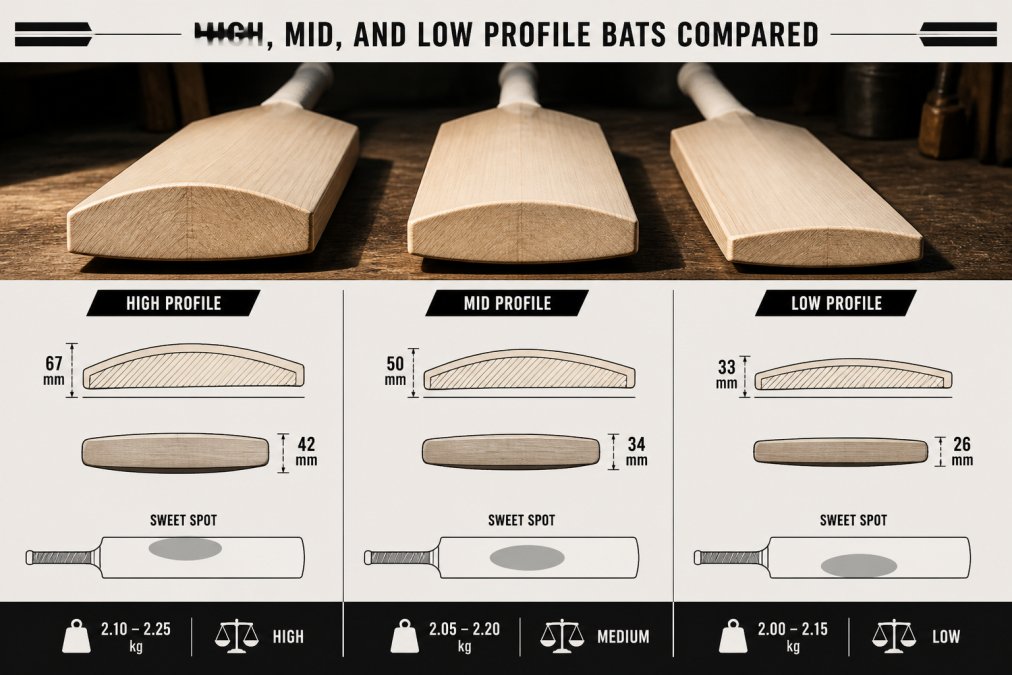
The clearest way to understand profile differences is to look at what each design does to the bat's weight distribution, balance point, and impact zone. A high profile bat concentrates mass in the upper half of the blade. A low profile bat pushes it toward the toe. A mid profile sits between the two.
High Profile (High Middle) Bats
A high profile bat positions the sweet spot in the upper third of the blade, roughly level with or just below the maker's label. The spine height is pronounced, often sitting above 65mm on premium clefts, and the edges are typically thick throughout the upper blade.
For fast bowling, this profile rewards top-hand dominant technique. Front-foot drives, cover drives struck on the up, and pulls played at chest height all benefit from a high middle because the impact zone aligns with where the ball arrives on a length or back-of-a-length delivery.
Pros: Excellent for front-foot drives and on-the-up play. Rebound quality is strong for deliveries arriving at mid-stump height. Works well on hard, true pitches.
Cons: Less effective for yorkers and low full-tosses. Bottom-heavy shots sacrifice some power. Can feel top-heavy, affecting swing speed for smaller-framed players.
Mid Profile Bats
Mid profile bats place the maximum thickness and sweet spot roughly in the centre of the blade. This is the most versatile design, which is why it dominates the market. The balance point sits naturally in the hand, making the bat feel lighter than its stated weight.
For fast bowling, a mid profile suits players who mix front-foot and back-foot play in roughly equal measure. The impact zone covers a broader range of delivery lengths, which matters when facing bowlers who vary their line and length deliberately.
Pros: Versatile across delivery lengths and pitch types. Balanced pick-up suits most batting grips and techniques. Performs well on both hard and slightly damp pitches.
Cons: Neither the best for pure front-foot play nor the best for back-foot dominance. Players with a very defined style often find a specialised profile outperforms it.
Low Profile (Low Middle) Bats
Low profile bats concentrate the sweet spot in the lower third of the blade, closer to the toe. The spine tapers more gradually from the shoulders down, and the maximum thickness sits well below the mid-point.
This is the profile for back-foot players. Short-pitched deliveries, cut shots, pulls, and hooks all connect in the lower half of the bat face. Against fast bowlers who target the body and short of a length, a low middle bat turns that short ball into a scoring opportunity.
Pros: Exceptional for pull shots, cuts, and back-foot play. Ideal for bouncy pitches where the ball rises sharply. Suits players with strong bottom-hand technique and wrist play.
Cons: Front-foot drives struck in the upper blade lose power noticeably. Less effective on low, slow pitches where the ball skids through.
Profile Type |
Sweet Spot Position |
Best For |
Pitch Conditions |
Playing Style |
|---|---|---|---|---|
High Profile |
Upper blade |
Front-foot drives, on-the-up play |
Hard, true, consistent bounce |
Top-hand dominant |
Mid Profile |
Centre blade |
All-round play |
Most pitch types |
Balanced technique |
Low Profile |
Lower blade / toe |
Back-foot play, pulls, cuts |
Bouncy, short-pitched |
Bottom-hand, wrist play |
Cricket Bat Sweet Spot Position and How It Changes Against Pace
The cricket bat sweet spot position is the area of the blade that produces maximum rebound energy on impact. Against a bowler operating at genuine speed, the ball reaches the bat face in roughly 0.4 to 0.5 seconds from release, leaving almost no margin to adjust. The sweet spot needs to be where the ball is going to be.
This is why choosing bat profile for fast bowlers is fundamentally different from choosing one for conditions where you have time to manipulate the ball. On a fast pitch, the delivery that rears from back-of-a-length will arrive at a very different height than the same delivery on a slow surface. Your profile choice needs to account for that.
If you find yourself consistently middling the ball when facing spin but hitting it off the toe or high on the blade against pace, your sweet spot position is misaligned with your natural contact zone against quick bowling.
The Physics of Ball-on-Bat Impact at High Velocity
When a cricket ball travelling at high velocity strikes the bat face, it compresses against the willow for a fraction of a millisecond before rebounding. The energy transfer during that compression phase determines how far the ball travels. Two factors govern it: the stiffness of the bat at the point of contact, and the mass distribution around that contact point.
A bat with high spine height and thick edges at the impact zone stores and returns energy more efficiently because the willow is denser at that point. According to Sports Technology International research on cricket bat performance, the coefficient of restitution varies meaningfully across different zones of the blade, with the sweet spot consistently outperforming the edges and toe by a significant margin.
At high velocity, the bat also flexes along its handle. MCC's Laws and technical guidance on bat construction acknowledges that handle flex contributes to the overall feel of the bat at impact. For fast bowling, where the impact force is at its greatest, handle flex becomes a meaningful variable in bat selection.
Best Cricket Bat Weight for Fast Bowling
The best cricket bat weight for fast bowling sits in the range where you can generate maximum bat speed without sacrificing the mass needed for effective energy transfer. Most experienced players find this balance somewhere between 2lb 7oz and 2lb 10oz, though the right weight is genuinely individual.
Heavier bats carry more mass into the ball, but if the extra weight costs you bat speed through the hitting zone, you lose more than you gain. Bat speed is the dominant variable in ball speed off the bat. A faster swing with a slightly lighter bat will outperform a slower swing with a heavier one.
The pick-up of a bat matters as much as its stated weight. A bat with a low balance point can feel noticeably lighter than its weight suggests because the mass is distributed toward the handle end. For players who face a lot of short-pitched deliveries and rely on pull shots and cuts, a slightly lighter bat (2lb 7oz to 2lb 8oz) allows faster swing speed. For front-foot dominant players on hard pitches, a touch more weight (2lb 9oz to 2lb 10oz) can add power to drives without meaningfully reducing swing speed.
SGM Cricket Bats builds each bat to the player's specified weight range, with the balance point adjusted to match the profile.
How Pitch Conditions Should Shape Your Bat Profile Choice
Pitch conditions are the variable most players overlook when choosing bat profile for fast bowlers.
On a hard, fast pitch with true bounce, the ball arrives at consistent height. Front-foot play is rewarded, and a high to mid profile bat aligns well with the delivery arc. On a bouncy pitch with variable lift, short-pitched deliveries become the dominant threat, and a high profile bat becomes more useful because the impact zone sits where the ball is actually arriving. On a slow, low pitch, the ball skids through rather than rising, and a low to mid profile bat is more effective.
According to Cricket Australia's pitch preparation and condition guidelines, pitches across different regions vary significantly in their pace and bounce characteristics, which reinforces why a one-profile-for-all approach leaves players at a disadvantage.
Quick reference for pitch-to-profile matching:
- Hard, true bounce: high or mid profile
- Bouncy, variable lift: high profile
- Slow, low pitch: low or mid profile
- Green, seaming pitch: mid profile (versatility matters more than specialisation)
Spine Height, Edge Thickness, and the Role of the Cleft
These three specifications are where choosing bat profile for fast bowlers gets genuinely technical.
Spine height is the measurement of the bat's maximum thickness at the back of the blade. A higher spine concentrates more willow mass in a narrower zone, which increases the density at the sweet spot. For fast bowling, a pronounced spine (above 60mm on a full-size bat) produces better energy return on high-velocity impact.
Edge thickness determines how much willow is available at the bat's widest points. Thick edges (above 38mm) extend the effective hitting zone outward, which matters when fast deliveries hit the outer edge of the bat face.
The cleft is the raw piece of English willow from which the bat is shaped. Cleft quality determines everything that follows. A well-selected cleft with straight, tight grains and the right moisture content produces a bat that performs immediately and holds its performance over time.
At SGM Cricket Bats, every cleft is hand-selected before shaping begins. The grain count, wood density, and moisture content are all assessed individually because two clefts from the same tree can perform very differently once shaped and knocked in.
Drill-Based Testing: How to Confirm Your Bat Profile Works for You
Most players buy a bat and find out whether the profile suits them during a match. There's a better way.
Drill 1: The Length Ball Contact Test
Face a bowling machine or a consistent net bowler at 120-130 km/h. Play 20 consecutive defensive pushes to good-length deliveries without trying to score. After each shot, note where on the blade the contact occurred. If the majority of contacts fall within the sweet spot, the profile is aligned with your natural technique. If contacts cluster above or below the sweet spot consistently, the profile needs adjustment.
Drill 2: The Short-Ball Reaction Test
Set the bowling machine to deliver short-pitched balls at 130+ km/h. Play 15 pull shots without pre-meditation. The goal is not to hit them hard but to find the middle of the bat naturally. A bat profile that suits your back-foot play will produce a noticeably different sound and feel on contact.
Drill 3: The Drive Timing Test
Play 20 front-foot drives off a full or overpitched delivery. Focus entirely on timing rather than power. A well-matched profile will produce drives that feel effortless when timed correctly.
Maintenance and Its Impact on Profile Performance Over Time
A cricket bat's profile performance degrades over time through a process of fibre compression and surface hardening. The willow fibres that give the bat its rebound quality gradually compress with use, reducing the bat's ability to return energy on impact. This process happens fastest at the sweet spot because that's where the highest-impact contacts occur.
Proper oiling and knocking-in slow this process significantly. Linseed oil applied to the face, edges, and toe keeps the willow fibres supple and prevents surface cracking that accelerates compression. The MCC's guidance on bat care and preparation recommends regular light oiling throughout the season rather than heavy oiling at the start.
The edges are particularly vulnerable on high-profile bats used against fast bowling because the edge contact force is higher.
Maintenance schedule for fast bowling use:
- Pre-season: two to three light coats of raw linseed oil, 24 hours apart, face and edges only
- During season: one light coat of oil every four to six weeks, or after any session on a wet outfield
- After each use: inspect the edges and face for surface cracks; sand lightly with fine-grain sandpaper if cracks appear
- Toe protection: apply a toe guard or fibre tape before the season begins
A well-maintained bat from a quality cleft will hold its profile performance for several seasons of regular club cricket.
Custom Cricket Bat Delivery Time and What to Expect
Custom cricket bat delivery time is a common concern, particularly for players with tournaments approaching. A genuinely handcrafted bat cannot be rushed without compromising the result.
At SGM Cricket Bats, the bats take 3 weeks to deliver from the date of placing the order. That timeline covers cleft selection, shaping, pressing, handle fitting, finishing, and final inspection. Each stage is done by hand in our own factory, which is not located in Australia, meaning every bat receives individual attention rather than moving through an automated production line.
What to expect during the custom process:
- Order placement: You specify your weight range, profile preference, handle type, and any additional customisation through the configurator on the SGM custom bat page.
- Cleft selection: Our team selects a cleft that matches your specifications. For players who want input at this stage, we can discuss grain count and density preferences.
- Shaping and pressing: The blade is shaped to your profile and pressed to the appropriate hardness for your playing level.
- Handle fitting and finishing: The handle is fitted and bound to your preference. Final sanding and finishing bring the bat to its ready-to-knock-in state.
- Dispatch: The bat is inspected and dispatched. Knocking-in and oiling remain the player's responsibility before first use.
The Cricket Australia's equipment guidelines for club and representative cricket confirm that custom-made bats are fully compliant for all levels of play, provided they meet standard dimensional specifications, which all SGM bats do.
Choosing bat profile for fast bowlers is a decision that shapes every session you play against pace. SGM Cricket Bats takes the guesswork out of that decision by building each bat to your exact profile specifications, from spine height and edge thickness to weight and balance point, using hand-selected English willow clefts assessed individually before a single cut is made. Whether you're looking at the Players Grade for technique-driven batting or the Reserve Edition for the finest willow available, the custom bat process ensures your profile works for your game. Shop now and start the process of getting a bat that's built around how you actually play.

Frequently Asked Questions
Which bat profile is best for playing fast bowling?
A mid-to-high profile bat suits most players facing fast bowling. The higher sweet spot position rewards back-foot play and short-pitched deliveries, reducing the risk of mistiming balls that rear up sharply. Players with a more front-foot, drive-based game can still use a mid profile effectively. The right choice depends on your batting technique, typical pitch conditions, and swing speed. A custom bat lets you dial in the exact profile for your style rather than compromising with an off-the-shelf option.
How does sweet spot position affect performance against pace?
Against fast bowling, the ball arrives with significantly more force and less time to react. A higher sweet spot position means the impact zone aligns with where the ball typically reaches after pitching short or at a good length on bouncy pitches. When the ball strikes outside the sweet spot, rebound quality drops sharply and the handle transmits more vibration to your hands. Matching your sweet spot to the delivery length you face most often is one of the most practical improvements you can make to your bat profile selection.
What is the best bat weight for facing fast bowlers?
Most club cricketers facing fast bowling perform best with a bat between 1.18 kg and 1.25 kg. Heavier bats increase impact force but reduce bat speed and reaction time, which matters enormously against pace. A bat that feels heavy in the pick-up will cost you a fraction of a second at the crease, and that fraction is enough to miss the sweet spot entirely. Balance point matters as much as raw weight: a bottom-heavy bat swings slower than a top-heavy bat of identical mass.
How long does it take to receive a custom SGM cricket bat?
SGM Cricket Bats builds every bat to order in their own factory, and delivery takes 3 weeks from the date you place your order. That timeline covers cleft selection, shaping, pressing, and final inspection. If you have a tournament coming up, place your order at least three weeks out to ensure your bat arrives ready to knock in and use. The SGM custom bat configurator lets you specify willow grade, weight, and profile before ordering.


