

Table of Contents
- How to Inspect a Cricket Bat Before You Buy
- The Cricket Bat Willow Grading System Explained
- Cricket Bat Grain Count Importance: What Actually Matters
- Signs of Poor Quality English Willow to Watch For
- Difference Between English and Kashmir Willow
- Why Cheap English Willow Bats Fail Early
- What a Well-Made English Willow Bat Looks Like
- Frequently Asked Questions
Last Updated: September 10, 2026
How to Inspect a Cricket Bat Before You Buy
Knowing the signs of poor quality English willow comes down to a handful of checks you can do in under two minutes. Look at the grain, feel the pick-up, inspect the face for stains and filler, and listen to the tap. Get those four right and you will avoid most bad bats on the market.

Every cleft is inspected by hand before it becomes a bat, so makers see exactly where cheap willow gives itself away. Below, we'll show you the checks run in a factory, in the order they run them.
The bat-buying problem is simple: two bats can look identical on a shelf and play nothing alike. One has tight, straight grain and a clean face. The other has a butterfly stain hidden under the sticker and a dead spot near the splice. This guide gives you the seven checks that separate them.
The Cricket Bat Willow Grading System Explained
The cricket bat willow grading system sorts clefts by appearance, not performance (lords.org). Grades run from Grade 1 (cleanest grain, fewest blemishes) down through Grades 2 and 3, with "players grade" and "reserve" labels used by makers to signal their best stock.

Here is the part most buyers get wrong. Grading is a cosmetic judgement made before the bat is shaped. A Grade 1 cleft can still produce a bat with a dull middle, and a Grade 3 cleft can produce a bat that pings beautifully. That is why serious makers select on performance first and grade second.
Grain count is the most visible grading input, but it is only one variable. Straightness, even spacing, and the absence of stain all feed into the grade.
Cricket Bat Grain Count Importance: What Actually Matters
Grain count matters less than grain quality. A bat with 10 straight, evenly spaced grains will generally outperform a bat with 14 wavy ones, because straight grain indicates the cleft was split along the natural fibre of the willow.
Grain count importance is real, but it is often oversold. More grains do not automatically mean more power. What you want is:
- Straight grains running cleanly from shoulder to toe
- Even spacing with no sudden widening
- No blemishes interrupting the grain lines
- A minimum of six grains on any bat you intend to use seriously
The Marylebone Cricket Club's Laws of Cricket govern the bat's dimensions, but they say nothing about grain count. Grain is a quality signal, not a rule.
Signs of Poor Quality English Willow to Watch For
The clearest signs of poor quality English willow are butterfly stain, sapwood discolouration, dead spots, knots, and filled cracks. Any one of these can shorten a bat's life or kill its performance.
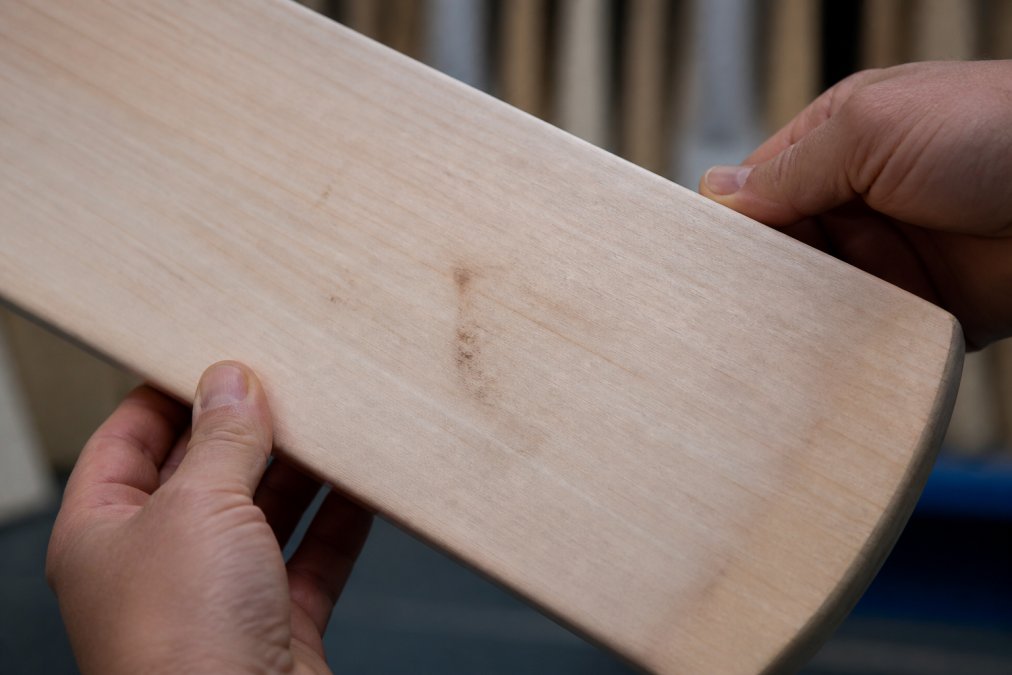
Walk into any cricket shop and run these checks in order. Start at the face, work to the edges, then finish with the tap test.
Butterfly Stain and Sapwood Discolouration
Butterfly stain is a dark, butterfly-shaped mark in the willow, usually near the toe or edge. It develops where the tree took up minerals unevenly, and it is a genuine weakness, not just a cosmetic flaw. Bats with heavy butterfly stain tend to crack through the stained area.
Sapwood discolouration is the pale, greyish or streaky band that runs along the edge of the blade. It signals that the bat was cut too close to the outside of the log, where the wood is softer and less dense.
Both flaws are easy to spot under good light. If a seller keeps the bat in dim lighting, ask to take it to a window.
Dead Spots, Knots and Filled Cracks
A dead spot is an area of the blade that does not respond when you tap it. Hold the bat by the handle, tap the face with a ball or your knuckle, and listen. A healthy bat gives a sharp, ringing response across the whole face. A dead spot sounds flat and muted.
Knots are small dark circles in the grain. Small, tight knots are tolerable. Large or loose knots are a structural risk.
Filled cracks are the worst of the three. If you can see a colour change along a crack line, or feel a slight ridge with your fingernail, the bat has been repaired. Filler hides damage; it does not fix it.
Difference Between English and Kashmir Willow
The difference between English and Kashmir willow comes down to density, origin, and how the bat plays. English willow (Salix alba caerulea) grows in cooler, wetter conditions, producing lighter, springier timber. Kashmir willow is denser and heavier, with a shorter fibre structure.
In practice, that means:
- English willow gives better ping and a lighter pick-up for the same size
- Kashmir willow is more durable in the short term but feels dead off the middle
- English willow costs more because the growing and grading process is slower
For club and representative cricket, English willow is the standard. Kashmir willow is a reasonable starting point for juniors and casual players. The UK's Forestry Commission guidance on willow cultivation explains why the growing conditions matter so much to the final timber.
Why Cheap English Willow Bats Fail Early
Cheap English willow bats fail early because they are made from low-grade clefts, rushed through shaping, and sold without proper pressing. Three things go wrong at once.
First, low-grade clefts have more hidden flaws. Second, mass production skips the slow pressing stage that compresses the fibres and adds durability. Third, cheap bats are often sold pre-oiled and pre-knocked, which sounds convenient but usually means the preparation was done badly.
The result is a bat that pings for a month and then goes soft. You feel it first on the edges, then across the whole face.
What a Well-Made English Willow Bat Looks Like
A well-made English willow bat has straight, evenly spaced grain, a clean face with no stain or filler, a sharp tap across the whole blade, and a pick-up that feels lighter than its weight suggests. Those four signs together tell you more than any grade sticker.
SGM Cricket Bats builds bats this way in our own Melbourne factory. We hand-select every cleft, press it properly, and finish each bat by hand. Our Cricket Bat Buying Guide walks through grade, weight and profile selection in detail.

If you want the bat built around your game rather than pulled off a rack, our Custom Made Cricket Bats start at $699 and are ready in three weeks from the day you choose your willow. For players who want premium willow without full customisation, the Reserve Edition English Willow Cricket Bat at $799 offers a minimum of 8 to 10 grains and is built for the top level.
| Check | What Good Looks Like | What Poor Quality Looks Like |
|---|---|---|
| Grain | Straight, even, 6+ lines | Wavy, uneven, under 6 |
| Face | Clean, no marks | Butterfly stain or filler |
| Tap test | Sharp ring across face | Flat or muted spots |
| Pick-up | Feels light for its weight | Feels heavy and dead |
| Edges | Solid, no grey band | Sapwood discolouration |
Buying a bat blind is a fast way to waste money on willow that will not last a season. SGM Cricket Bats manages every step in-house, from cleft selection to final inspection, so the bat you receive has already passed the checks in this guide. Choose your willow grade, weight and profile through its custom configurator, or step up to the Reserve Edition for premium grain built for representative cricket. Get started with SGM Cricket Bats and bat with willow you can trust.
Frequently Asked Questions
What are the visual signs of low-grade English willow?
Look for wide, uneven grain spacing, dark butterfly stain across the blade, visible knots, and filled cracks near the splice or toe. A low-grade blade often feels dead when tapped and shows no clear straight grain running from shoulder to toe. Pale, washed-out colour with no definition between growth rings is another giveaway. If the face looks flat and lifeless rather than tight and even, the willow is unlikely to perform.
Does the number of grains on a cricket bat indicate quality?
Grain count is a rough guide, not a guarantee. A bat with 8 to 10 straight, evenly spaced grains usually comes from a slower-grown tree, which tends to be denser and more durable. However, grain count alone does not determine performance. A blade with 12 tight grains but a large knot or butterfly stain can still play worse than a clean 7-grain bat. Judge grain alongside blemish, weight distribution and how the bat responds when tapped.
How can you tell the difference between English and Kashmir willow?
English willow (Salix alba caerulea) is pale cream to light brown with fine, straight grain and a soft, springy feel. Kashmir willow is darker, often reddish-brown, with wider grain and a harder, denser surface that feels stiffer. Kashmir bats are heavier for the same size and tend to lack the ping of English willow. The difference between English and Kashmir willow shows most clearly in the grain pattern and the sound the bat makes when tapped.
Are knots and blemishes in willow always a sign of poor quality?
Not always. Small, tight knots that sit away from the hitting zone are cosmetic and will not affect performance. Butterfly stain, which appears as a dark butterfly-shaped mark, is also mostly cosmetic if the surrounding grain is straight and tight. The problem arises when a knot or stain sits in the middle of the blade, weakens the grain flow, or comes with a filled crack. Those are genuine signs of poor quality English willow and should be avoided.


